
Guide
Manufacturing Readiness Level (MRL): The Complete Guide for Aerospace and Defense Engineers
Download PDF![[hero] Manufacturing Readiness Level (MRL) guide](https://www.modusadvanced.com/hs-fs/hubfs/%5Bhero%5D%20Manufacturing%20Readiness%20Level%20(MRL)%20guide.png?width=1024&height=768&name=%5Bhero%5D%20Manufacturing%20Readiness%20Level%20(MRL)%20guide.png)
Table of Contents
Table of Contents
Key Points
- Manufacturing readiness level (MRL) is a DoD framework: it provides a structured, 10-level scale for assessing whether a manufacturing process is mature enough to support the program phase it's in — from early research through full-rate production.
- MRLs map directly to Technology Readiness Levels (TRLs): understanding both together prevents the costly mistake of advancing a technology into production before the manufacturing process can reliably support it.
- Each MRL gate is a qualification milestone: it defines whether your manufacturing process can reliably deliver conforming parts under real production conditions, not just demonstrate feasibility.
- DFM integration at early MRLs prevents late-stage failures: design decisions made at MRL 3–5 determine what's manufacturable at MRL 8–10, and changing course late is expensive.
- Precision converter partners directly affect your MRL advancement: a manufacturing partner with deep process control, certified quality systems, and engineering depth can be the difference between clearing a gate on schedule and missing it.
Don't have time to read this? Take a copy with you:
Download PDF- 1What Manufacturing Readiness Level Actually Measures — and Why It Matters
- 2The MRL Scale: All 10 Levels Defined
- 3MRL Level Summary Table
- 4The Manufacturing Readiness Assessment Process: How Programs Are Actually Evaluated
- 5Why DFM Integration at Early MRLs Determines Late-Stage Success
- 6The Supply Chain's Role in MRL Advancement
- 7MRL in Medical Device Development: The Framework Your FDA Submission Doesn't Tell You About
- 8Certifications as MRL Signals: What Quality System Credentials Actually Tell You
- 9Modus Advanced and MRL Advancement: What a Capable Manufacturing Partner Provides
- 10Practical MRL Planning: What Engineering Teams Should Be Doing at Each Phase
- 11Common MRL Mistakes That Delay Programs
- 12Frequently Asked Questions: Manufacturing Readiness Levels
- 13The Stakes of Getting MRL Wrong
- 14Partner With a Manufacturer Who Understands What MRL Advancement Requires
- 15Download this Guide
- 1What Manufacturing Readiness Level Actually Measures — and Why It Matters
- 2The MRL Scale: All 10 Levels Defined
- 3MRL Level Summary Table
- 4The Manufacturing Readiness Assessment Process: How Programs Are Actually Evaluated
- 5Why DFM Integration at Early MRLs Determines Late-Stage Success
- 6The Supply Chain's Role in MRL Advancement
- 7MRL in Medical Device Development: The Framework Your FDA Submission Doesn't Tell You About
- 8Certifications as MRL Signals: What Quality System Credentials Actually Tell You
- 9Modus Advanced and MRL Advancement: What a Capable Manufacturing Partner Provides
- 10Practical MRL Planning: What Engineering Teams Should Be Doing at Each Phase
- 11Common MRL Mistakes That Delay Programs
- 12Frequently Asked Questions: Manufacturing Readiness Levels
- 13The Stakes of Getting MRL Wrong
- 14Partner With a Manufacturer Who Understands What MRL Advancement Requires
- 15Download this Guide
Table of Contents
Select Your Chapter
Chapter 1
What Manufacturing Readiness Level Actually Measures — and Why It Matters
A program that fields a technically brilliant system too early has failed just as surely as one that never fielded anything at all. Manufacturing readiness levels exist because engineering history is full of programs where the technology worked and the manufacturing didn't — where parts couldn't be made to spec in volume, where yields collapsed under production conditions, or where costs ballooned the moment low-rate production began.
The DoD developed the MRL framework to force that conversation early. MRLs provide a disciplined method for assessing manufacturing maturity in parallel with technology maturity — not after the fact, when fixing problems costs ten times as much.
For engineers working on aerospace and defense programs, MRLs aren't bureaucratic overhead. They're a systematic way to ask the hardest question in any program: can we actually build this, at scale, to the quality the mission demands?
The Relationship Between MRL and TRL
Understanding the difference between MRL and TRL is where most programs either get it right early or pay for it later. Technology Readiness Levels measure whether a technology works. Manufacturing Readiness Levels measure whether you can build it. Both scales run from 1 to 10, and both need to advance together.
The danger zone is a widening gap between the two. A technology at TRL 7 — demonstrated in an operationally relevant environment — sitting on top of a manufacturing process at MRL 4 means you know it works but you don't know if you can build it. Programs that accept that gap and push forward anyway tend to meet it again at the worst possible time: during milestone reviews, during LRIP, or in the field.
The MRL framework, codified in the DoD Manufacturing Readiness Level Deskbook, defines clear criteria for each level and the activities required to advance. It's the standard against which program offices, prime contractors, and supply chain partners are all evaluated.
What Happens When MRL and TRL Diverge
When TRL advances significantly faster than MRL, the program carries manufacturing risk that milestone reviews will surface — usually at the worst possible moment. The most common causes: design teams not integrated with manufacturing early, materials chosen for technical performance without regard to production availability, and processes that work in lab conditions but haven't been characterized under real production loads.
Closing a TRL/MRL gap late in a program is expensive. Closing it at MRL 4 or 5 — when the design is still responsive to DFM feedback and processes are still being defined — is just engineering. The difference between those two situations is usually whether manufacturing was part of the conversation from the start.
.jpg?width=1200&height=627&name=8%20RF%20Shielding%20Techniques%20to%20Know%20About%20(1).jpg)
Related
The Benefits of Vertical Integration
Find out how vertical integration can improve part quality and reduce lead times.
See HowChapter 2
The MRL Scale: All 10 Levels Defined
The 10 MRL levels span the full program lifecycle, from early research through sustained full-rate production. Understanding what each level actually requires — not just its name — is what allows engineering teams to plan ahead rather than scramble to catch up.
MRL 1–3: Basic Research and Feasibility
These early levels don't require mature manufacturing processes. They require honest assessment of whether manufacturing is even possible, and what the basic constraints look like.
MRL 1 — Basic Manufacturing Implications Identified
Manufacturing feasibility is purely conceptual at this stage. The focus is identifying that a manufacturing challenge exists — not solving it. Teams are asking whether the materials and processes needed to build the envisioned system are theoretically achievable.
MRL 2 — Manufacturing Concepts Identified
Specific manufacturing concepts are identified that could produce the technology. There's no hardware yet, but the manufacturing approach is beginning to take shape on paper. Material candidates and basic process families are being considered.
MRL 3 — Manufacturing Proof of Concept Developed
Manufacturing concepts are validated through analytical study or laboratory experimentation. Some manufacturing processes are being tested at the lab scale. This is where early design decisions begin to carry real consequences for what will be manufacturable later.
MRL 4–6: Technology Development and Risk Reduction
These middle levels are where manufacturing capability starts to be demonstrated rather than theorized. They're also where the gap between design intent and production reality tends to surface first. Closing the gap between MRL 4 and MRL 6 requires deliberate process discipline — not just more hardware builds.
MRL 4 — Capability to Produce the Technology in a Laboratory Environment
Manufacturing processes have been demonstrated in a laboratory environment. Producibility assessments are underway. Key manufacturing risks are being identified and documented.
MRL 5 — Capability to Produce Prototype Components in a Production-Relevant Environment
This is a significant step. Prototype components are being produced using processes that reflect production intent — not just lab workarounds. Material sources are being qualified. Process control begins to take on real meaning here.
MRL 6 — Capability to Produce a Prototype System or Subsystem in a Production-Relevant Environment
A prototype system or subsystem has been produced in a production-relevant environment. Manufacturing processes are defined and characterized. Preliminary manufacturing plans exist. This level typically aligns with the Milestone B decision point, and programs that haven't achieved MRL 6 at Milestone B face significant acquisition risk.
MRL 7–8: Engineering and Manufacturing Development
These levels represent the transition from development to production. Manufacturing must prove it can deliver — not just demonstrate capability in controlled conditions.
MRL 7 — Capability to Produce Systems, Subsystems, or Components in a Production-Representative Environment
Manufacturing processes are in statistical control or moving toward it. A detailed manufacturing plan is in place. The production facility is identified and being qualified. Tooling, fixturing, and test equipment reflect production intent. This level aligns with Milestone C readiness. Understanding what MRL 7 actually requires — and the evidence package that supports it — is where many programs discover gaps they should have closed two phases earlier.
MRL 8 — Pilot Line Capability Demonstrated; Ready to Begin Low-Rate Initial Production (LRIP)
MRL 8 is the manufacturing clearance for LRIP. All manufacturing processes are proven and in statistical control. Yield and throughput are understood. The cost model is validated against actual production data. Supply chain is established and qualified.
This is the level where every upstream decision about materials, tolerances, and process selection either pays off or creates problems. Parts that weren't designed for manufacturability at MRL 4 become expensive, schedule-breaking problems at MRL 8.
MRL 9 — Low-Rate Production Demonstrated; Capability in Place to Begin Full-Rate Production (FRP)
LRIP is complete. Full-rate production readiness is demonstrated. Quality systems are fully operational. The manufacturing process has been validated under real production conditions, not just pilot conditions. All supply chain risks have been addressed.
MRL 10: Full-Rate Production and Continuous Improvement
MRL 10 — Full-Rate Production Demonstrated and Lean Production Practices in Place
The system is in full-rate production. Manufacturing processes are optimized. Lean practices are in place and driving continuous improvement. Cost reduction initiatives are active. The program has demonstrated sustained production capability at the required rate and quality level.
MRL 10 isn't a finish line — it's a steady state that requires active maintenance. Supply chain changes, material obsolescence, and evolving quality requirements mean that even established production programs need ongoing manufacturing management.
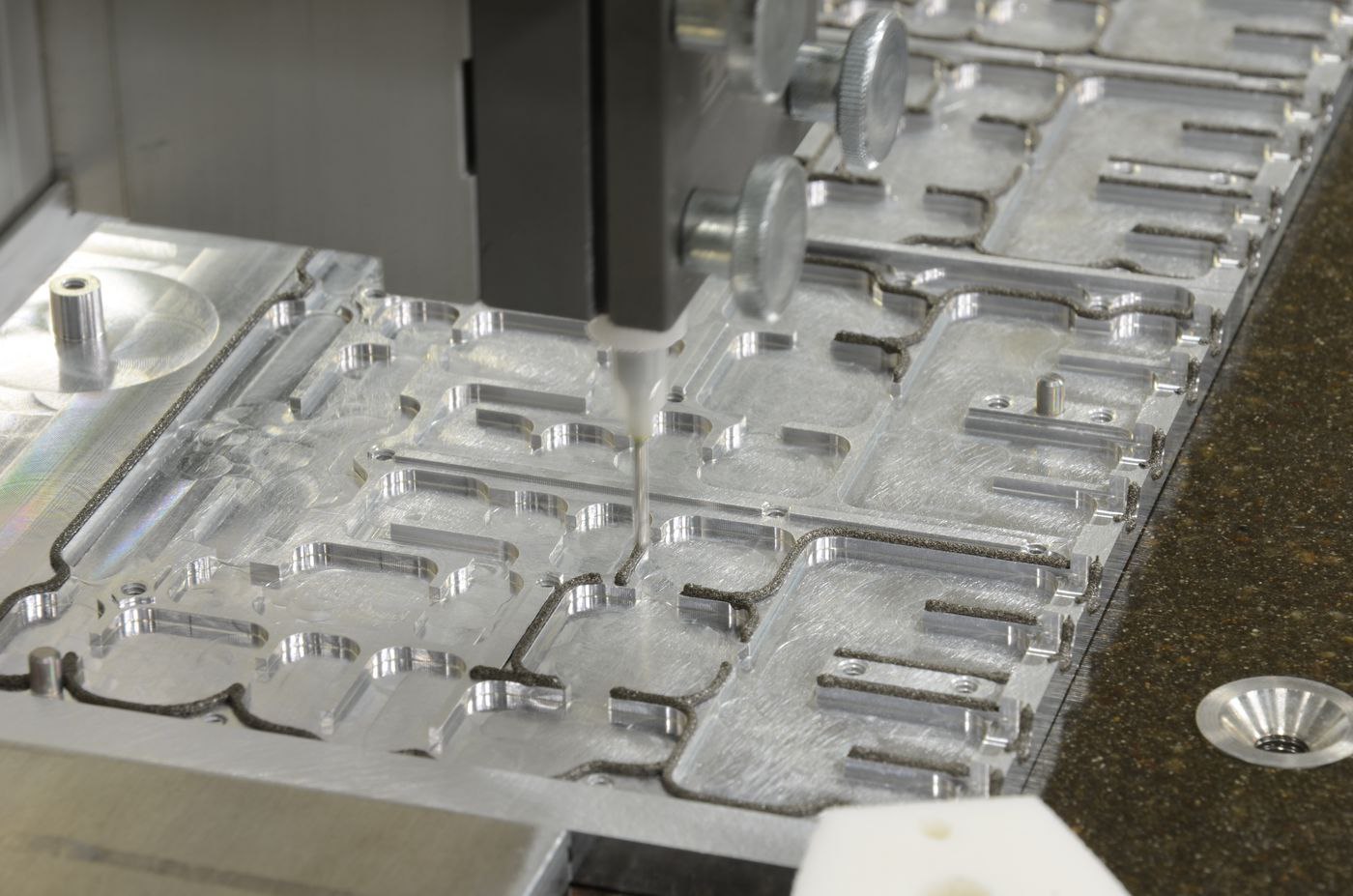
Capabilities
Review all of Modus's Manufacturing Capabilities
See the full breadth of custom manufacturing services we can offer.
CapabilitiesChapter 3
MRL Level Summary Table
The table below consolidates all 10 MRL levels into a single reference view, mapping each level to its program phase, corresponding DoD acquisition milestone, and the defining requirement that must be satisfied to claim that rating.
MRL | Name | Program Phase | Acquisition Milestone Alignment | Key Requirement |
|---|---|---|---|---|
1 | Basic manufacturing implications identified | Basic Research | Pre-Milestone A | Feasibility conceptualized |
2 | Manufacturing concepts identified | Basic Research | Pre-Milestone A | Manufacturing approach on paper |
3 | Manufacturing proof of concept developed | Applied Research | Pre-Milestone A | Lab-scale process validation |
4 | Capability to produce in lab environment | Technology Development | Pre-Milestone A / A | Producibility assessment underway |
5 | Capability to produce prototype components | Technology Development | Post-Milestone A | Production-relevant process demonstrated |
6 | Capability to produce prototype system | Technology Development | Milestone B | Processes defined and characterized |
7 | Capability to produce in production-representative environment | Engineering & Mfg Dev | Milestone C | Statistical process control initiated |
8 | Pilot line capability demonstrated | LRIP Readiness | Post-Milestone C | All processes proven, cost model validated |
9 | Low-rate production demonstrated | FRP Readiness | FRP Decision | LRIP complete, full-rate readiness confirmed |
10 | Full-rate production demonstrated | Sustainment | Sustainment | Lean practices active, continuous improvement ongoing |
Chapter 4
The Manufacturing Readiness Assessment Process: How Programs Are Actually Evaluated
Knowing what each MRL requires is necessary. Knowing how Manufacturing Readiness Level Assessments are conducted is what lets you prepare for them rather than react to them.
Manufacturing Readiness Assessments (MRAs)
A Manufacturing Readiness Assessment is the formal process by which a program's manufacturing maturity is evaluated against MRL criteria. MRAs are conducted by teams that include program office representatives, independent reviewers, and often prime contractor and supply chain personnel. The assessment examines manufacturing processes, quality systems, supply chain status, cost and schedule data, and risk mitigation plans.
MRAs are typically required at major program milestones — Milestone B, Milestone C, and production decisions. They can also be conducted at interim points when a program needs to demonstrate progress or resolve identified risks.
The assessment output is a formal MRL rating with documented rationale and identified gaps. Those gaps become action items that must be resolved before advancing to the next milestone.
Key Manufacturing Risk Areas Evaluated in MRAs
Every MRA examines manufacturing risk across a consistent set of domains. Understanding these domains helps engineering teams identify where their programs are most vulnerable.
Risk Domain | What Assessors Examine |
|---|---|
Design and materials | Design for manufacturability, material availability, and qualification status |
Process capability | Statistical process control data, yield rates, and defect data |
Quality management | Quality systems, inspection methods, and traceability |
Manufacturing workforce | Skills availability and training documentation |
Facilities and tooling | Production facility readiness and tooling qualification |
Supply chain | Supplier qualification, sole-source risks, and lead times |
Cost and funding | Should-cost estimates versus actuals, and learning curve validation |
Production planning | Master production schedule, capacity analysis, and ramp plans |
Common MRA Failure Modes
Most programs that struggle in MRAs aren't struggling because of a single catastrophic problem. They're accumulating risk across multiple domains simultaneously.
- Design freeze delayed too long: changes past MRL 6 drive expensive retooling and requalification
- Process capability not characterized: asserting process control without statistical data doesn't survive independent review
- Supply chain not qualified in time: single-source suppliers and long-lead-time materials that haven't been formally qualified represent schedule risk that assessors will flag immediately
- Tolerance stack-ups not validated in production conditions: parts that pass inspection in prototype quantities can produce unacceptable yield in pilot-line conditions
- Quality system not fully operational: documented procedures that exist on paper but haven't been exercised in production conditions
- Cost model built on optimistic assumptions: should-cost estimates that haven't been validated against actual production data will be challenged
Chapter 5
Why DFM Integration at Early MRLs Determines Late-Stage Success
The most expensive engineering decisions in a program's manufacturing lifecycle are the ones made at MRL 3 that look like design decisions. Material selection, geometric complexity, tolerancing philosophy, assembly sequence — all of these determine what the manufacturing process will need to be capable of, long before anyone runs a pilot line.
Design for Manufacturability reviews aren't a late-stage checkpoint. DFM is a continuous discipline that should be active from the first time a design concept is sketched. Programs that treat DFM as something you do before handing off to production carry avoidable risk into every subsequent MRL gate.
What DFM Review Actually Involves
A meaningful DFM review isn't a checklist sign-off. It's a structured engineering conversation about how a design will actually be manufactured — what processes it requires, what tolerances those processes can reliably hold, and where the design is creating unnecessary manufacturing complexity.
Effective DFM reviews examine:
- Material selection and availability: whether the specified materials are producible in the required form, available from qualified sources, and compatible with required manufacturing processes
- Tolerance assignment: whether specified tolerances reflect what processes can actually hold in production, or whether they've been tightened beyond functional need in ways that will drive yield loss
- Feature geometry: whether geometric complexity creates manufacturing challenges that could be avoided without functional compromise
- Assembly considerations: whether the design can be assembled reliably at production rates, with the workforce skills available
- Inspection and verification: whether critical characteristics can actually be inspected using available metrology, at production throughput rates
- Supply chain implications: whether the design requires specialized materials or processes from limited sources that create supply chain risk
Tolerancing and What Processes Can Actually Hold
One of the most common sources of MRL advancement problems is the gap between design tolerances and process capability. Engineers specifying tight tolerances on die-cut elastomeric components without understanding what converters can reliably hold are setting up yield problems that won't surface until pilot-line conditions.
For die-cut elastomeric components — commonly used in aerospace and defense applications for EMI shielding gaskets, environmental seals, and thermal interface materials — standard length and width tolerances vary by material type and dimension. Film materials (BL1) in dimensions under 25.4 mm (1.0") hold ±0.25 mm (±0.010"). Solid or dense materials (BL2) in the same dimension range hold ±0.38 mm (±0.015"). Sponge and foam materials (BL3) hold ±0.63 mm (±0.025") for dimensions under 25.4 mm (1.0").
These are production-realistic tolerances. Tighter tolerances are achievable with engineering solutions, but they come with longer lead times and higher costs — and should only be specified when the design or function truly requires them. Calling out a tolerance tighter than what the process can sustain at normal conditions is a yield problem waiting to appear at MRL 8.
For Form-in-Place (FIP) dispensed gaskets, standard bead tolerances are ±0.15 mm (±0.006") for most applications. Start, stop, and T-joint zones carry additional variation that must be accounted for in the housing design — typically -30% to +45% from nominal height and width in the 3 mm regions around those features.
The engineers who make MRL advancement look straightforward are the ones who had these conversations at MRL 3 and 4, not at MRL 7.
Chapter 6
The Supply Chain's Role in MRL Advancement
A program's MRL rating is only as strong as its weakest supply chain link. Prime contractors and system integrators who assess their own manufacturing maturity without simultaneously managing supply chain risk at each manufacturing readiness level are carrying unquantified risk.
Supplier Manufacturing Maturity Assessment
For components where supplier manufacturing capability directly affects system performance — and in precision aerospace and defense applications, that's most of them — the manufacturing readiness of the supply base needs to be assessed alongside the prime's own processes.
Assessors will ask about supplier qualification status, process capability data from suppliers, and what oversight mechanisms are in place to ensure supplier performance during LRIP and FRP. Answers that rely on supplier self-reporting without independent verification tend not to survive MRA scrutiny.
What Makes a Supplier Ready to Support MRL Advancement
Not all suppliers are equipped to support programs across the full MRL progression. The ones that are tend to share certain characteristics.
Capability | Why It Matters for MRL Advancement |
|---|---|
Certified quality management system (AS9100, ISO 9001) | Provides the quality infrastructure assessors expect to see at MRL 6 and above |
Statistical process control | Demonstrates that processes are characterized and in control, not just capable in ideal conditions |
DFM engineering support | Enables manufacturability feedback at early MRLs when it's still inexpensive to act on |
Vertical integration | Reduces inter-supplier handoffs that create qualification gaps and supply chain risk |
Metrology and inspection capability | Ensures that conformance can be verified, not just asserted |
ITAR compliance | Required for defense programs; suppliers without it create legal and program risk |
Prototype-to-production continuity | The supplier who built the prototype should be able to scale to production; transitions between suppliers create requalification burden |
Managing Long Lead Times and Material Availability
Supply chain risk in MRL assessments frequently comes down to materials and lead times. Parts that require exotic materials, specialized processing, or sole-source suppliers are risk flags in every MRA. The question assessors are asking isn't just whether the material exists — it's whether it can be obtained, in the required form, from qualified sources, at production rates, with the lead times the program schedule can absorb.
Programs that haven't mapped this out before Milestone B tend to discover the problem after Milestone B. Material qualification takes time. Supplier qualification takes time. Building those activities into the program schedule at MRL 4 and 5 means they're complete when MRL 7 and 8 assessments require them.
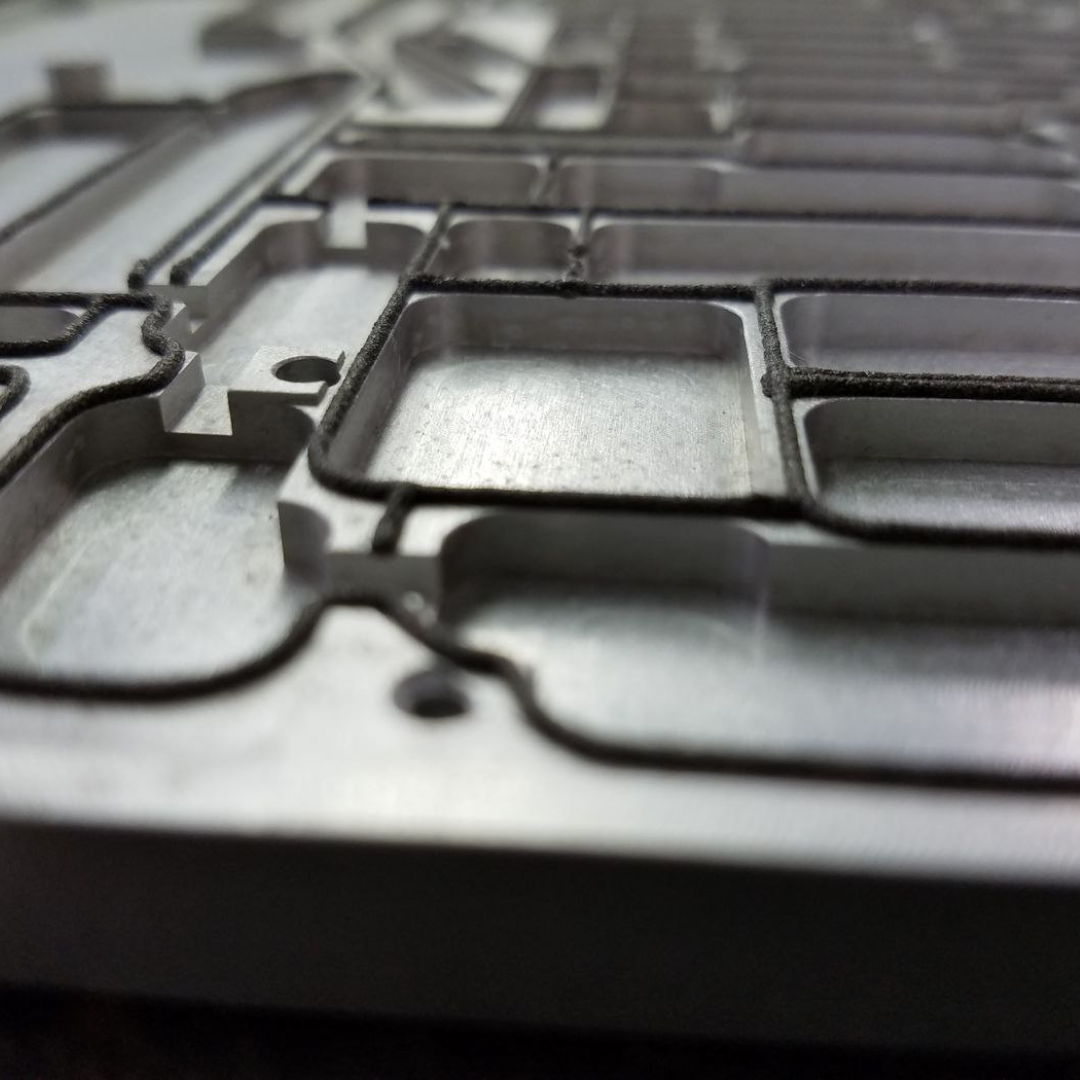
True Partnership
Small Bead FIP: Breaking the Bead Size Boundaries of Form-In-Place Gaskets
As technology advances, electronics and devices are shrinking in size to accommodate more complex project designs–simply put, they require more technology in less space. It pays to have a manufacturing part who is willing to push the boundaries.
Explore MaterialsChapter 7
MRL in Medical Device Development: The Framework Your FDA Submission Doesn't Tell You About
Most published guidance on manufacturing readiness levels focuses exclusively on aerospace and defense. But the underlying discipline — manufacturing process maturity tracked in parallel with design maturity — applies directly to medical device development, where the stakes are equally consequential and the regulatory requirements are similarly exacting.
The FDA's process validation framework for medical devices maps closely to MRL thinking. The three stages of process validation defined in the FDA's Process Validation Guidance for Industry (2011) — Process Design, Process Qualification, and Continued Process Verification — correspond roughly to the MRL 4–6, MRL 7–8, and MRL 9–10 progressions. Design freeze in medical device development carries the same implications as the MRL 6 gate in defense programs: changes after that point are expensive, require formal change control, and can trigger revalidation.
For medical device OEMs working with contract manufacturers on precision-cut components — elastomeric seals, adhesive interface layers, gaskets for implantable housings — the same questions that determine MRL advancement in defense programs apply directly. Is the manufacturing process characterized? Are tolerances assigned based on what the process can actually hold? Is the supplier's quality system auditable? Can the supplier produce at prototype volumes and scale to production using the same processes?
The manufacturer who helps a medical device OEM answer those questions early — before design freeze, before verification and validation — is doing the same work a capable defense supply chain partner does at MRL 4 and 5. The urgency is identical. A ventilator component that can't be reliably manufactured is a patient outcome problem, not just a production problem.
.png?width=1024&height=768&name=Telecommunciations%20(1).png)
Case Study
Redefining the Traditional Supplier Relationship to Create a 10 Year Partnership
Learn how Modus has worked to create a long-term partnership with this DoD Telecommunications company.
See HowChapter 8
Certifications as MRL Signals: What Quality System Credentials Actually Tell You
Certifications don't replace manufacturing maturity. Assessors know the difference between a certificate on the wall and a quality system that's actively functioning in production. That said, certifications are meaningful signals — they indicate that a quality management system has been audited against a recognized standard, and that the infrastructure for process control, documentation, and corrective action is in place.
AS9100 certification covers the quality management system requirements specific to aerospace and defense manufacturing. At MRL 6 and above, assessors expect to see this infrastructure in place for suppliers working on flight-critical or mission-critical components. AS9100 doesn't certify process capability — but it does certify that the systems for achieving and maintaining process capability are present and audited.
ISO 9001 is the foundation beneath AS9100. It establishes the quality management system baseline that makes higher-level certifications meaningful. Suppliers who hold ISO 9001 but not AS9100 may be appropriate for certain program tiers; suppliers who hold neither are operating quality systems that MRA assessors will scrutinize closely.
ITAR compliance isn't a quality certification — it's a legal requirement for defense programs involving controlled technical data and hardware. Suppliers who aren't ITAR-registered create program risk that extends beyond quality: export control violations carry consequences that no MRL rating can mitigate.
Statistical process control isn't a certification, but it's what MRL 7 and 8 assessors are actually looking for when they ask about process maturity. A supplier who can produce SPC charts demonstrating process capability — not just inspection records showing conforming parts — is demonstrating exactly what the MRL framework requires.
Think of certifications this way: they confirm that the infrastructure is in place. Process capability data confirms that the infrastructure is working.
Chapter 9
Modus Advanced and MRL Advancement: What a Capable Manufacturing Partner Provides
Manufacturing partners aren't passive participants in MRL advancement. The right partner contributes directly to a program's ability to clear gates on schedule — through engineering depth, process control, quality systems, and the ability to sustain production performance under real production conditions. Vertical integration in particular supports manufacturing readiness in ways that fragmented supply chains structurally cannot.
Engineering Support From the First Drawing
Modus engineers work directly with customer engineering teams from early program phases. This isn't a pre-sales courtesy — it's how DFM problems get caught at MRL 3 and 4 instead of MRL 7 and 8. Engineers who have spent years running die-cutting and FIP dispensing processes know exactly where designs create manufacturability risk, and they can say so directly.
More than 10% of Modus staff are engineers, distributed across every functional area — quoting, quality, machining, FIP dispensing, and materials. The engineer reviewing your design for manufacturability is the same type of engineer who will be responsible for building it. The feedback is grounded in what the process will actually do, not what it theoretically can do.
Process Capability and Quality Infrastructure
Modus holds ±0.13 mm (±0.005") on die-cut parts — tighter than standard industry tolerances. That capability matters to programs where dimensional precision is a functional requirement, not just a quality metric.
The quality infrastructure behind that capability includes AS9100 and ISO 9001 certification, covering the quality management systems that MRL assessors expect to see in place at MRL 6 and above. ITAR certification covers the security and compliance requirements that defense programs can't proceed without.
Process control is maintained through direct measurement and inspection, with quality engineers embedded in the production process — not sitting in a separate building reviewing paperwork. That's the infrastructure programs need when they're defending MRL ratings to independent assessors.
Vertical Integration and Reduced Qualification Risk
Modus controls the full process from material selection through shipping. That vertical integration isn't just an efficiency advantage — it's a qualification advantage. Every handoff between suppliers is a potential gap in the qualification chain. When one partner handles material selection, die cutting, FIP dispensing, and final inspection under a single quality management system, the qualification story is cleaner, the traceability is complete, and the MRA documentation is easier to produce.
For programs managing complex assemblies that combine elastomeric die-cut components, FIP gaskets, machined metal housings, and thermal materials, that matters.
Prototype-to-Production Continuity
Programs that prototype with one supplier and produce with another carry a requalification burden that MRL timelines often can't absorb. The processes used in prototype production aren't identical to production processes, but they should be close enough that the transition is managed — not a discovery process.
Modus supports programs from prototype volumes through production, using production-intent processes from the beginning. When a part moves from MRL 5 prototype to MRL 8 pilot line, the manufacturing process data generated at prototype stage is relevant to the production qualification — because the same process, at the same facility, with the same quality system, built both.
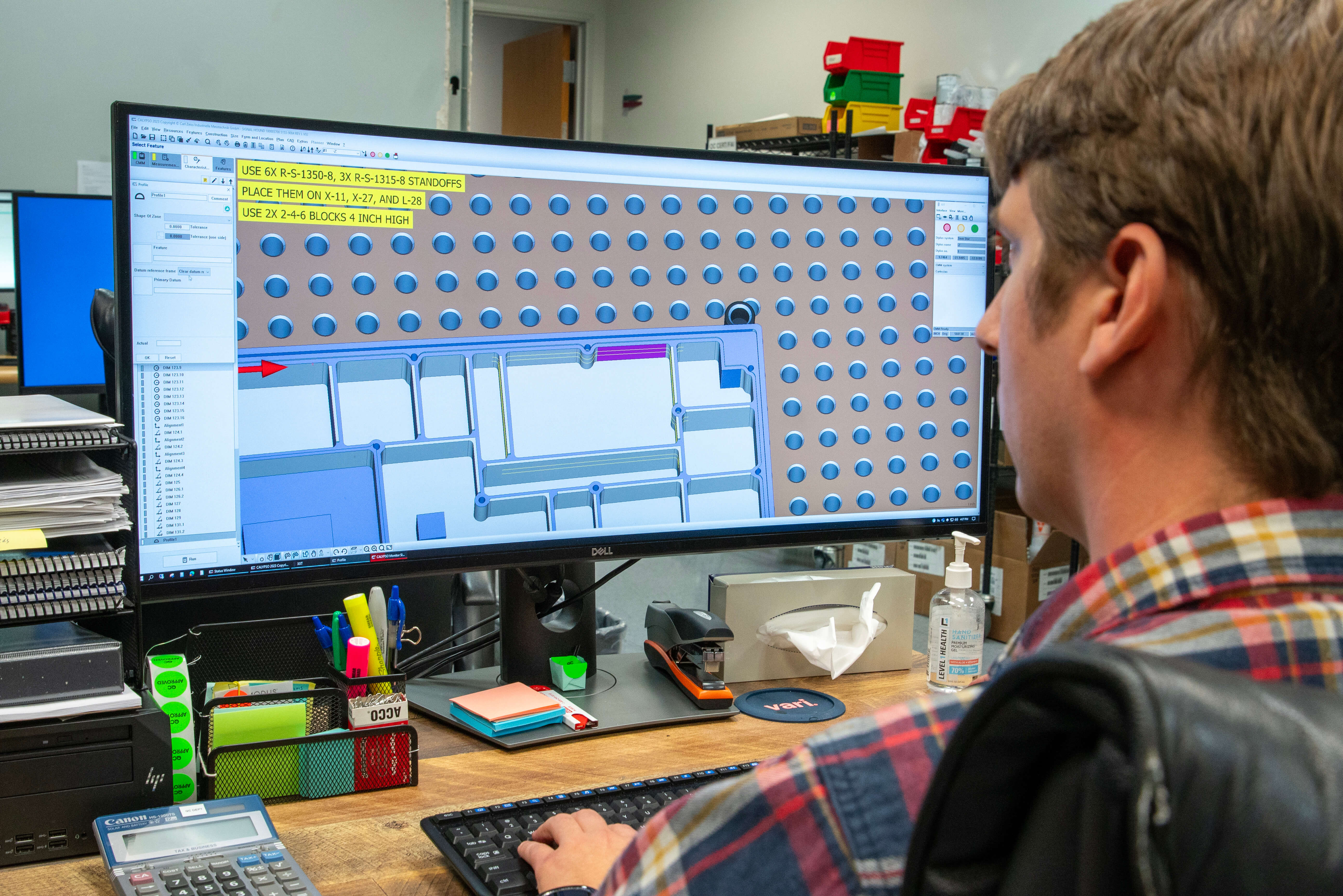
Related
What Happens During a DfM Review?
Get a full breakdown of how the Design for Manufacturability Review process works at Modus.
DfM ProcessChapter 10
Practical MRL Planning: What Engineering Teams Should Be Doing at Each Phase
The MRL framework is useful as an assessment tool. It's more useful as a planning tool. Engineering teams that know what MRL 6 requires can begin working toward it at MRL 3 instead of discovering at MRL 6 what they should have done two phases earlier. A program manager's MRL roadmap from breadboard to full-rate production makes that planning concrete across every program phase.
Early Phase Planning (MRL 1–4)
The decisions made in these early levels set the manufacturing trajectory for the entire program. Getting the fundamentals right here — materials, process selection, partner engagement — is far less expensive than correcting them later.
- Identify manufacturing approach early: don't wait for a design to stabilize before beginning the manufacturing conversation — begin it in parallel
- Select materials with production availability in mind: a material that works in the lab but isn't available from qualified production sources is a supply chain risk from the moment it's specified
- Engage manufacturing partners for DFM review: a converter or machined-component supplier who reviews the design at MRL 3 can flag problems that would require redesign at MRL 6
- Document manufacturing assumptions: assessors at MRL 4 want to see that manufacturing risks have been identified and are being tracked, even if they haven't been resolved yet
- Identify critical manufacturing processes: know which processes carry the highest technical risk and begin developing the plan to characterize and control them
Mid-Phase Planning (MRL 5–7)
These levels are where manufacturing intent gets tested against manufacturing reality. The work done here determines whether the program arrives at Milestone C with demonstrated capability or with open risk items.
- Produce prototypes using production-intent processes: prototype parts built using workaround processes generate data that won't translate to production; use the real process from the beginning
- Begin statistical process control development: don't wait until MRL 7 to start collecting process capability data; the data generated at MRL 5 and 6 builds the baseline for MRL 7 demonstration
- Qualify suppliers formally: supplier qualification isn't a handshake — it requires documented assessment, quality system review, and first-article inspection; start early enough that qualification is complete before you need it
- Validate tolerance assignments against actual process capability: get measured data from the processes you're planning to use; if the data shows the process can't reliably hold the tolerance, fix the tolerance or fix the process before MRL 7
- Complete preliminary manufacturing plan: MRL 6 requires a manufacturing plan; it doesn't need to be the final plan, but it needs to reflect real decisions about process, facility, tooling, and workforce
Late-Phase Planning (MRL 8–10)
At MRL 8, the time for theoretical arguments about what the process can do is over. These levels require demonstrated production performance, and every activity in this phase should be oriented toward building and sustaining it.
- Execute pilot line with production intent: the pilot line is where the manufacturing process proves itself under production conditions; it should not be an extended prototype run
- Collect and analyze yield data: yield loss in pilot production is expected; what matters is that it's being measured, analyzed, and driven down systematically
- Validate cost model against actuals: cost modeling and should-cost analysis across manufacturing readiness levels must be recalibrated against actual pilot-line production data before full-rate production decisions
- Implement continuous improvement processes: MRL 10 requires lean practices in place; build the improvement culture during LRIP rather than trying to install it at full-rate production
- Maintain supply chain qualification currency: supplier qualifications don't last forever; ensure that the qualification status of critical suppliers is being actively maintained, not just assumed
Chapter 11
Common MRL Mistakes That Delay Programs
Programs don't typically fail MRL gates catastrophically. They slip — by weeks, then months — as accumulated small problems compound into schedule risk that eventually becomes program risk.
The mistakes that cause those slips are consistent across programs. Worth naming directly.
Treating MRL as a documentation exercise. MRL ratings that are asserted without underlying process data don't survive independent review. MRL advancement requires demonstrated capability, not documented claims of capability.
Advancing design past MRL 6 without a stable BOM. Engineering changes after MRL 6 are expensive. Every change that affects a qualified manufacturing process requires requalification of that process. Programs that allow design churn past Milestone B are trading schedule margin for feature flexibility, and the exchange rate is poor.
Underestimating process development time for novel materials or geometries. If the design requires a manufacturing process that hasn't been fully characterized, characterizing it takes time. That time needs to be in the program schedule at MRL 4, not discovered as a gap at MRL 7.
Failing to address sole-source material risk. A single qualified source for a critical material is a schedule risk in every program review. Identifying that risk at MRL 4 and beginning the qualification of an alternate source gives programs options. Identifying it at MRL 8, when schedule pressure is highest, gives programs problems.
Treating quality system certification as a manufacturing maturity surrogate. AS9100 certification means a quality management system is in place and has been audited. It does not mean manufacturing processes are in statistical control, yields are acceptable, or the supply chain is qualified. MRAs evaluate all of those things independently.
Chapter 12
Frequently Asked Questions: Manufacturing Readiness Levels
These questions address the most common gaps engineers and program managers encounter when working with the MRL framework.
What is a manufacturing readiness level (MRL)?
A manufacturing readiness level (MRL) is a measure of the maturity of a manufacturing process on a scale from 1 to 10. The scale was developed by the U.S. Department of Defense to assess whether a manufacturing process is capable of supporting the current phase of a defense acquisition program. MRL 1 represents basic identification of manufacturing feasibility; MRL 10 represents full-rate production with lean practices in place. The framework is defined in the DoD Manufacturing Readiness Level Deskbook.
What is the difference between MRL and TRL?
Technology Readiness Level (TRL) measures how mature a technology is — whether it has been demonstrated in a laboratory, in a relevant environment, or in operational conditions. Manufacturing Readiness Level (MRL) measures how mature the manufacturing process for that technology is — whether it can be produced reliably, at volume, under real production conditions. Both scales run from 1 to 10. TRL and MRL should advance together; a large gap between them — such as TRL 7 with MRL 4 — indicates that a technology is maturing faster than the manufacturing capability to produce it, which is a significant program risk.
What are the 10 manufacturing readiness levels?
The 10 MRL levels are: (1) Basic manufacturing implications identified, (2) Manufacturing concepts identified, (3) Manufacturing proof of concept developed, (4) Capability to produce in a laboratory environment, (5) Capability to produce prototype components in a production-relevant environment, (6) Capability to produce a prototype system in a production-relevant environment, (7) Capability to produce in a production-representative environment, (8) Pilot line capability demonstrated — ready for LRIP, (9) Low-rate production demonstrated — ready for full-rate production, (10) Full-rate production demonstrated with lean practices in place.
What MRL is required for full-rate production?
MRL 9 is the threshold for full-rate production readiness. At MRL 9, low-rate initial production (LRIP) has been completed, quality systems are fully operational, and the manufacturing process has been validated under real production conditions. MRL 10 indicates that full-rate production is actively underway, with lean practices and continuous improvement processes in place.
How is a Manufacturing Readiness Assessment (MRA) conducted?
A Manufacturing Readiness Assessment is a structured evaluation of a program's manufacturing maturity against MRL criteria. Assessment teams typically include program office representatives, independent reviewers, and supply chain personnel. The assessment examines manufacturing processes, quality systems, supply chain qualification status, cost and schedule data, and risk mitigation plans. MRAs are formally required at Milestone B, Milestone C, and full-rate production decisions. The output is a documented MRL rating with identified gaps and required corrective actions.
What does MRL 6 mean?
MRL 6 means a prototype system or subsystem has been produced in a production-relevant environment — one that reflects actual production conditions, not just laboratory conditions. At MRL 6, manufacturing processes are defined and characterized, and a preliminary manufacturing plan exists. MRL 6 is the expected readiness level at Milestone B in DoD acquisition programs. Programs that cannot demonstrate MRL 6 at Milestone B carry formal manufacturing risk that must be documented and mitigated.
Do manufacturing readiness levels apply outside of defense programs?
The MRL framework was developed for DoD defense acquisition, but the underlying discipline applies to any domain where manufacturing process maturity needs to advance in parallel with design maturity. Medical device development has direct parallels: the FDA's three-stage process validation framework (Process Design, Process Qualification, Continued Process Verification) maps closely to the MRL 4–6, 7–8, and 9–10 progressions. Commercial aerospace and industrial programs increasingly apply MRL-style thinking even when not contractually required, because the discipline catches manufacturing risk early — when it's still inexpensive to address.
Chapter 13
The Stakes of Getting MRL Wrong
There's a version of this conversation that stays entirely inside the program office — milestone reviews, MRA ratings, acquisition risk. That version is important, and it's the one most engineers are measured against.
There's another version that goes further. The systems being built at MRL 8 and 9 — the components making their way through LRIP toward full-rate production — are going somewhere. Into aircraft that pilots will fly. Into equipment that service members will carry. Into medical devices that patients will depend on.
Manufacturing maturity isn't an abstraction in those contexts. A process that isn't in statistical control produces parts that vary. Parts that vary beyond design tolerances fail to perform as designed. Systems that fail to perform as designed create consequences that the MRL framework exists precisely to prevent.
That's why the DoD built this framework. That's why program offices enforce it. And that's why engineering teams who internalize the discipline — who engage DFM early, characterize their processes honestly, and choose manufacturing partners who can deliver verified capability rather than assertions — produce programs that get to the field on schedule and perform when they get there.
One day matters. In aerospace and defense, it usually does.
Chapter 14
Partner With a Manufacturer Who Understands What MRL Advancement Requires
Modus Advanced works with aerospace and defense programs across the full MRL progression — from early DFM reviews at MRL 3 and 4 through production support at MRL 8 and beyond. Our engineering team, quality systems (AS9100, ISO 9001, ITAR), and vertically integrated capabilities are structured to support programs where precision and reliability aren't optional.
If your program is approaching a milestone review, managing a DFM challenge, or qualifying a manufacturing process for LRIP, let's solve this together. Because failure isn't an option here.
Contact Modus Advanced to discuss your program's manufacturing readiness needs.
Don't have time to read the entire guide now?
We'll email you a downloadable PDF version of the guide and you can read it later.
Get Started
Speak to an Engineer Today
Don’t take our word for it. Reach out and speak to one of our engineers about your part today and see the benefits for yourself. We strive to turn all quotes around 48 hours or less to get your part moving as quickly as possible.
Submit a Design