The Rise of Laser Communication in Space Systems
Space-based laser communication is transforming how satellites transmit data between spacecraft and ground stations. Laser communication — also called optical communication — uses narrow beams of infrared light to transmit information at dramatically higher speeds with lower power consumption than traditional radio frequency systems.
The Department of Defense is investing heavily in this technology through programs like the Space Development Agency's Proliferated Warfighter Space Architecture. DoD plans to deploy hundreds of satellites equipped with laser communication capabilities, representing billions of dollars in contracted work.
Laser communication component manufacturing requires precision that exceeds most aerospace applications. These systems must maintain optical alignment while operating in temperature extremes from -150°C (-238°F) to 150°C (302°F). A single component failure can compromise an entire satellite mission. This precision requirement parallels the challenges faced in manufacturing components for optical inter-satellite link systems, where alignment tolerances are equally demanding.
Essential Background Reading:
- OISL Component Manufacturing Guide: Foundation concepts for optical inter-satellite link systems and alignment tolerances
- Satellite Communication Component Manufacturing: Broader context for how subsystems integrate within spacecraft architectures
- EMI & RF Shielding Applications: Core principles of electromagnetic interference protection for electronics
- Form-in-Place Dispensing Capabilities: How FIP gaskets are robotically dispensed for precision shielding applications

Understanding Laser Communication Terminal Architecture
A laser communication terminal integrates several subsystems that must work together with exceptional precision. The telescope assembly captures and focuses laser light from distant transmitters. The pointing, acquisition, and tracking (PAT) system maintains alignment between moving platforms — a challenge given that satellites in Low-Earth Orbit move at approximately 7.6 km/second.
Each subsystem presents unique manufacturing challenges. Telescope mirrors must maintain surface accuracy despite thermal cycling. Pointing mechanisms require precise actuators capable of sub-micron positioning. Electronic assemblies need robust EMI shielding to prevent interference between high-speed data circuits and sensitive optical detectors. The broader context of satellite communication component manufacturing provides additional perspective on how these subsystems integrate within complete spacecraft architectures.
Subsystem | Key Components | Critical Manufacturing Requirements |
Optical Assembly | Primary/secondary mirrors, beam splitters | Precision machining, optical coatings, thermal stability |
Pointing System | Gimbal mechanisms, piezoelectric actuators | Tight mechanical tolerances, vibration isolation |
Optoelectronics | Laser diodes, photodetectors | Thermal management, EMI shielding, hermetic sealing |
Structural Housing | Enclosures, mounting brackets | CNC machining, FIP gaskets, thermal coatings |
Control Electronics | Driver circuits, signal processors | RF shielding, thermal dissipation, environmental sealing |
Thermal Management Challenges in Laser Communication Terminals
Thermal control represents one of the most demanding engineering challenges in laser communication systems. Laser diodes generate substantial waste heat during operation, and temperature variations directly impact pointing accuracy and signal quality.
Laser emission wavelength changes approximately 0.25 nm per degree Celsius of temperature increase. For communication links spanning thousands of kilometers — where the laser beam expands only about 500 meters at those distances — this thermal sensitivity directly impacts link margin.
Effective thermal management requires a multi-layered approach. Thermal interface materials must efficiently transfer heat from laser diodes to heat sinks. Gap filler pads provide conformable interfaces between irregular surfaces. Thermal coatings on external surfaces control solar absorption and infrared emittance. Understanding how black optical coatings optimize thermal performance in satellite laser terminals becomes essential for achieving reliable optical performance.
Die cutting and waterjet cutting produce precision-fit thermal pads from specialized materials. CNC machining creates heat sink geometries optimized for specific thermal loads. Thermal control coatings require carefully controlled application processes to achieve consistent optical properties.
Related Content:
- Satellite Payload Component Manufacturing: Precision tolerances for mission-critical spacecraft payload integration
- Satellite Bus Component Manufacturing: Structural and thermal solutions for spacecraft bus systems
- Black Optical Coatings for Laser Terminals: How optical coatings optimize thermal performance in satellite applications
- Thermal and Optical Control Coatings: Surface treatments for precise thermal management in extreme environments
- Thermal Management Solutions: Gap fillers, thermal pads, and interface materials for heat dissipation
EMI and RF Shielding for Sensitive Optical Electronics
Laser communication terminals operate alongside traditional RF systems on most satellite platforms. The high-speed digital circuits within optical terminals generate electromagnetic interference that can disrupt other spacecraft systems.
EMI shielding effectiveness requirements for space applications often exceed 90 dB across frequency ranges from 100 MHz to 18 GHz. Form-in-place gaskets have become the preferred solution for EMI shielding in compact satellite electronics, robotically dispensed directly onto machined aluminum housings.
Standard FIP bead tolerances of ±0.15 mm (±0.006") enable consistent shielding performance across production volumes. Conductive filler materials provide different combinations of shielding effectiveness, galvanic compatibility, and cost:
Material Type | Typical Shielding (dB) | Operating Temp Range | Best Applications |
Silver/Copper Filled | >90 | -50°C to 125°C (-58°F to 257°F) | High-performance shielding |
Silver/Nickel Filled | >100 | -50°C to 125°C (-58°F to 257°F) | Corrosion-resistant applications |
Nickel/Graphite Filled | >90 | -55°C to 125°C (-67°F to 257°F) | Aluminum-compatible housings |
Next Steps:
- Ground Station Component Manufacturing: Complete the link with terrestrial terminal manufacturing requirements
- Link 16 System Component Manufacturing: Defense communication systems with similar security and precision requirements
- SigShield™ Turnkey RF Sub-Assemblies: Learn how vertically integrated manufacturing accelerates complex RF shield production
- CNC Machining Capabilities: Detailed specifications for precision aluminum housing manufacturing
- Quality Management Systems: AS9100, ISO 9001, and ITAR compliance documentation
Precision CNC Machining for Optical Housings
The structural housings that protect laser communication optics must maintain dimensional stability across extreme temperature ranges. Aluminum alloys — particularly 6061-T6 — offer an excellent combination of machinability, thermal conductivity, and low density for space applications.
CNC machining enables the complex geometries required for modern laser communication terminals. Mounting surfaces require flatness specifications that ensure proper thermal contact and optical alignment. Gasket grooves must maintain consistent depth and width for reliable environmental sealing. These machining challenges mirror those encountered in satellite payload component manufacturing, where precision tolerances directly impact mission success.
Standard CNC machining tolerances of ±0.25 mm (±0.010") meet requirements for most structural features. Optical mounting surfaces often require tighter specifications. Advanced fixturing and tooling strategies can achieve tighter tolerances when design specifications demand it, though this increases both lead time and cost. Similar considerations apply when manufacturing precision components for satellite bus structures.
CMMC Compliance for Defense Laser Communication Programs
The defense industrial base faces cybersecurity requirements that directly impact manufacturing partners working on satellite laser communication programs. The Cybersecurity Maturity Model Certification program became a contractual requirement on November 10, 2025.
Defense contractors must achieve appropriate CMMC levels before contract award. Programs involving Controlled Unclassified Information typically require CMMC Level 2 certification through third-party assessment. Supply chain flow-down requirements extend these obligations to subcontractors who handle CUI.
CMMC compliance should be a threshold requirement when selecting manufacturing partners. A partner's failure to maintain certification can jeopardize contract awards and program schedules. ITAR registration remains equally important for programs involving export-controlled technical data. These security requirements are equally critical for tactical data link systems like Link 16, where information security directly impacts warfighter safety.
The Value of Vertical Integration for Complex Programs
Laser communication terminal manufacturing requires multiple specialized processes working in sequence. Traditional procurement involves separate vendors for machining, plating, gasket dispensing, and assembly — introducing coordination challenges and quality risks at each hand-off.
Vertical integration consolidates these processes under one roof with significant benefits:
- Reduced lead times: Concurrent manufacturing processes eliminate shipping time between vendors. Months compress to weeks.
- Lower risk: Single-source accountability with consistent quality standards across all processes.
- Better design feedback: Engineers who understand multiple processes identify improvements that optimize the complete system.
- Simplified logistics: One purchase order, one shipment, one quality documentation package.
For laser communication terminals requiring machined housings, FIP gaskets, thermal coatings, and assembled absorber materials, the SigShield approach exemplifies this integrated model. This same vertically integrated methodology proves valuable across demanding aerospace applications, including hypersonic aircraft component manufacturing and hypersonic weapons systems where thermal and EMI challenges are equally severe.
Engineering Partnership Throughout the Product Lifecycle
The most successful laser communication programs involve manufacturing partners early in the design cycle. Design for manufacturability reviews identify potential issues before designs are finalized.
Rapid iteration capability proves essential during prototyping. Laser communication systems often require multiple design-build-test cycles. A manufacturing partner comfortable with quick-turn prototype volumes enables faster learning cycles.
Direct access to manufacturing engineers provides value throughout this lifecycle. Creative engineering solutions often enable success when designs push standard process boundaries. This partnership approach extends to related systems including satellite ground station component manufacturing, where signal integrity requirements demand equally rigorous engineering collaboration. The same engineering partnership model supports hypersonic missile defense component manufacturing, where mission-critical performance tolerates no margin for error.
See It In Action:
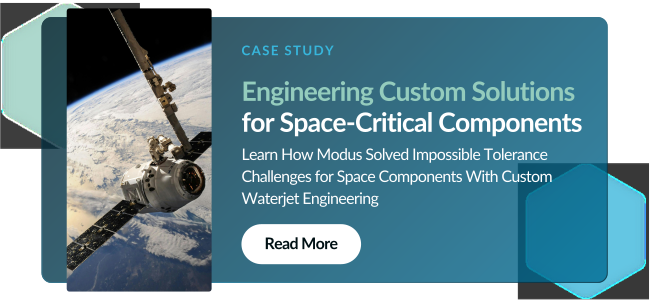
- Space Converting Case Study: Custom waterjet process development for space-critical components with tight profile tolerances
- Space Supply Chain Case Study: How deep materials knowledge resolved supply chain challenges for a space program
- Small Bead FIP Case Study: Breaking bead size boundaries for defense applications with intricate gasket requirements
- Signal Hound Vertical Integration Case Study: How vertical integration alleviated six months of production delays
Partner with Modus Advanced for Your Laser Communication Programs
Laser communication represents the future of space-based connectivity. Manufacturing the precision components these systems require demands specialized expertise across multiple processes.
Modus Advanced brings together CNC machining, FIP gasket dispensing, thermal management solutions, optical and thermal coatings, and precision converting operations under one roof. More than 10% of our staff are engineers who engage directly with customers on design for manufacturability and process optimization.
Our certifications — AS9100, ISO 9001, and ITAR registration — demonstrate our commitment to the quality and security standards that aerospace and defense programs require. CMMC Level 2 certification ensures we meet cybersecurity requirements now mandatory for defense contracts.
Contact our engineering team to discuss your specific requirements. We strive to turn all quotes around in 48 hours or less. Because when satellites rely on your technology to communicate across thousands of kilometers, one day matters.