
![[hero] Satellite Communication Component Manufacturing Precision Engineering for Defense and Commercial Space Applications (1)](https://www.modusadvanced.com/hs-fs/hubfs/%5Bhero%5D%20Satellite%20Communication%20Component%20Manufacturing%20Precision%20Engineering%20for%20Defense%20and%20Commercial%20Space%20Applications%20(1).png?width=1024&height=768&name=%5Bhero%5D%20Satellite%20Communication%20Component%20Manufacturing%20Precision%20Engineering%20for%20Defense%20and%20Commercial%20Space%20Applications%20(1).png)
Satellite communication component manufacturing encompasses precision fabrication of metal housings, RF shields, environmental seals, and thermal management parts that enable reliable signal transmission in space. These components must withstand temperature extremes from -157°C (-250°F) to 121°C (250°F) while maintaining electromagnetic shielding effectiveness and dimensional stability throughout multi-year missions.
For engineers developing defense and commercial satellite programs, selecting the right component manufacturing partner determines whether communication systems perform flawlessly or fail catastrophically. Every RF housing, environmental seal, and thermal interface affects mission success. Defense satellite communication payloads must maintain secure transmissions in contested electromagnetic environments. Commercial operators need components that maximize payload efficiency while achieving operational lifetimes justifying substantial launch investments.
This guide covers precision manufacturing capabilities essential for satellite communication applications. Topics include CNC machining for structural components, RF shielding solutions for signal integrity, form-in-place gaskets for environmental sealing, thermal management approaches for heat dissipation, specialized coatings for space performance, and quality standards protecting mission-critical systems.
Don't have time to read this? Take a copy with you:
Download PDFSelect Your Chapter
Satellite communication components require extreme precision manufacturing: Satellite communication components require extreme precision manufacturing: Parts must withstand temperature swings from -157°C (-250°F) to 121°C (250°F), radiation exposure, and multi-year operational demands without any opportunity for maintenance or repair.
Vertically integrated manufacturing reduces lead times and risk: Consolidating CNC machining, RF shielding, FIP gasket dispensing, thermal management, coatings, and converting under one roof eliminates quality hand-offs between multiple vendors and shortens delivery schedules.
CMMC Level 2 certification and DFARS compliance protect sensitive program data: Manufacturing partners serving defense satellite programs must meet cybersecurity requirements for handling controlled unclassified information throughout the production process.
Standard manufacturing tolerances serve most satellite applications: CNC machining achieves ±0.25 mm (±0.010") and FIP gaskets achieve ±0.15 mm (±0.006"), with tighter tolerances available through specialized engineering when mission requirements demand them.
Engineering support from design through production prevents costly failures: Early involvement by manufacturing engineers helps satellite system developers avoid redesigns and ensures components perform as intended in RF communication systems, MILSATCOM, Link 16, optical inter-satellite links, and ground stations.
Satellite communication component manufacturing serves diverse system architectures, each with unique requirements. Engineers designing components for these systems face distinct challenges depending on the operational environment, data throughput requirements, and security classification levels.
The following table summarizes manufacturing considerations across satellite communication system categories:
System Type | Frequency Range | Key Manufacturing Challenges | Critical Components |
UHF to Ka-band | EMI shielding effectiveness, thermal management | Phased arrays, transceivers, housings | |
~1.5 μm wavelength | Microradian alignment tolerances, thermal stability, optical coating precision | Optical head units, transceiver modules | |
Optical frequencies | Optical coating precision, contamination control | Telescope assemblies, beam steering | |
Multiple bands | Security compliance, jam resistance | Protected electronics, antenna systems | |
960-1,215 MHz | Interoperability, EMI shielding | Tactical data link terminals | |
Application-dependent | Environmental protection, RF isolation | Antenna feeds, high-power amplifiers |
Radio frequency communication systems form the backbone of traditional satellite communications. These systems transmit and receive signals across multiple frequency bands, including UHF, L-band, S-band, C-band, Ku-band, and Ka-band. Each frequency range demands specific component characteristics.
RF system components require exceptional EMI shielding to protect sensitive electronics from interference. Phased array antennas, communication transceivers, and control electronics all depend on precisely manufactured housings that maintain signal integrity. The electromagnetic environment in space — where solar radiation, cosmic rays, and signals from nearby satellites create constant interference threats — makes shielding effectiveness critical for multi-year missions.
Optical inter-satellite links represent a significant advancement in satellite-to-satellite communication. These systems use laser beams to transmit data between satellites, achieving data rates far exceeding traditional RF systems. OISL terminals typically operate at wavelengths around 1.5 μm and can achieve transfer rates of 1.8 Gbps or higher.
OISL terminal components require extraordinary precision. The optical head unit, transceiver module, and controller must maintain alignment tolerances measured in microradians. Thermal stability proves essential since temperature fluctuations can shift optical paths enough to break communication links. Manufacturing partners must understand both the precision requirements and the thermal management challenges these systems present.
Laser communication terminals extend optical communication beyond inter-satellite links to include space-to-ground connections. These systems enable high-bandwidth data transfer from satellites to ground stations, supporting applications from Earth observation data downlinks to secure military communications.
The Space Development Agency has identified optical inter-satellite links as one of the most critical technologies for future DoD constellations. Laser terminals must function reliably in radiation environments while maintaining precise optical alignment. Component manufacturing must account for how space radiation affects optical elements and electronic components over multi-year missions.
Military satellite communication (MILSATCOM) systems provide secure, protected, and jam-resistant communications for defense operations. These systems support everything from strategic nuclear command and control to tactical communications for deployed forces.
MILSATCOM components face unique manufacturing requirements beyond standard satellite hardware. Protected tactical SATCOM systems must detect and null enemy jamming through advanced on-board processing and antenna arrays. Components require manufacturing in secure facilities by vetted personnel with appropriate security clearances. ITAR registration and CMMC compliance become essential requirements rather than optional certifications.
Link 16 is a NATO standard tactical data link operating in the 960-1,215 MHz frequency range. This time-division multiple access (TDMA) system enables secure data exchange between aircraft, ships, ground forces, and command centers. Link 16 terminals increasingly integrate with satellite communication systems for extended range operations.
Manufacturing components for Link 16 systems requires understanding both the RF performance requirements and the security classification levels involved. These systems must maintain signal integrity in electronically contested environments while meeting strict interoperability standards across allied forces.
Ground stations anchor satellite communication networks to terrestrial infrastructure. These facilities house the antennas, receivers, transmitters, and processing equipment that interface with orbiting satellites. Ground station components face different environmental challenges than space-based hardware but still require precision manufacturing.
Ground station RF equipment needs robust EMI shielding to prevent interference between closely spaced systems. Thermal management becomes important for high-power transmitters and sensitive receiver electronics. Environmental sealing protects components from moisture, dust, and temperature extremes encountered at ground station locations worldwide.
Communication downlinks transfer data from satellites to ground receivers. High-data-rate downlinks for Earth observation, weather monitoring, and reconnaissance missions require components that can handle substantial power levels while maintaining signal quality.
Downlink system components include high-power amplifiers, antenna feed networks, and waveguide assemblies. Manufacturing these components demands precision machining capabilities combined with appropriate surface treatments to optimize RF performance.
Find out how vertical integration can improve part quality and reduce lead times.
See HowPrecision CNC machining forms the foundation of satellite communication component manufacturing. Metal housings, enclosures, brackets, and structural elements all require machining capabilities that deliver consistent results across prototype and production volumes.
Standard CNC machining tolerance reaches ±0.25 mm (±0.010") for metal components. This tolerance level serves the majority of satellite communication housing requirements while enabling efficient production. Materials commonly machined include 6061 aluminum, various steel alloys, copper alloys, and specialized aerospace materials.
Tighter tolerances are achievable through advanced fixturing, specialized tooling, and refined machining strategies. These enhanced capabilities come with increased lead times and costs. Engineers should specify tighter tolerances only when design or function truly requires them — overspecifying tolerance requirements adds expense without improving system performance.
RF shield housings represent a primary application for CNC machining in satellite communications. These enclosures protect sensitive electronics from electromagnetic interference while providing structural support and thermal pathways. The machined housing serves as the foundation for subsequent manufacturing steps including FIP gasket dispensing, surface treatments, and assembly of additional components.
Effective RF shield design requires close collaboration between design engineers and manufacturing partners. Wall thicknesses, gasket groove dimensions, mounting features, and surface flatness all impact shielding effectiveness. Early manufacturing involvement during the design phase prevents costly redesigns later in the development cycle.
See the full breadth of custom manufacturing services we can offer.
CapabilitiesRadio frequency shielding protects sensitive satellite communication electronics from electromagnetic interference. The space environment presents unique shielding challenges — solar radiation, cosmic rays, and signals from nearby spacecraft create constant interference threats that ground-based systems rarely encounter.
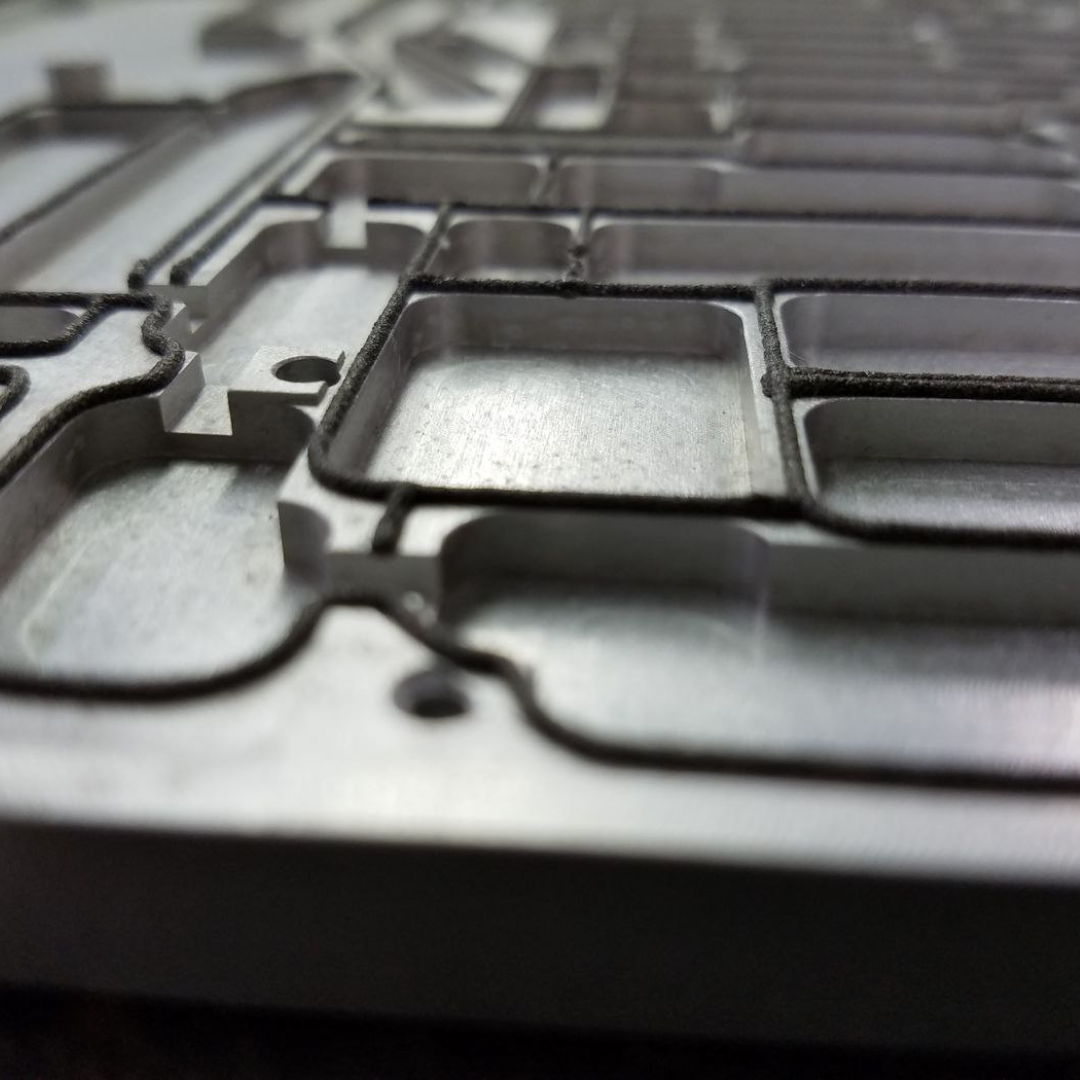
Effective RF shields for satellite applications typically require shielding effectiveness exceeding 80 dB across relevant frequency ranges. Achieving this performance level demands attention to every aspect of the shield assembly, from housing design through gasket selection to surface treatment specification.
The complete RF shield assembly includes the machined housing, conductive gaskets, surface treatments, and fastening hardware. Weakness in any element compromises overall shielding effectiveness. A precisely machined housing with poorly specified gaskets will underperform a well-integrated assembly using appropriately selected components throughout.
Multiple conductive filler materials enable EMI shielding in elastomeric gaskets. Material selection depends on shielding effectiveness requirements, galvanic compatibility with housing materials, environmental exposure, and cost constraints.
Common conductive filler options include:
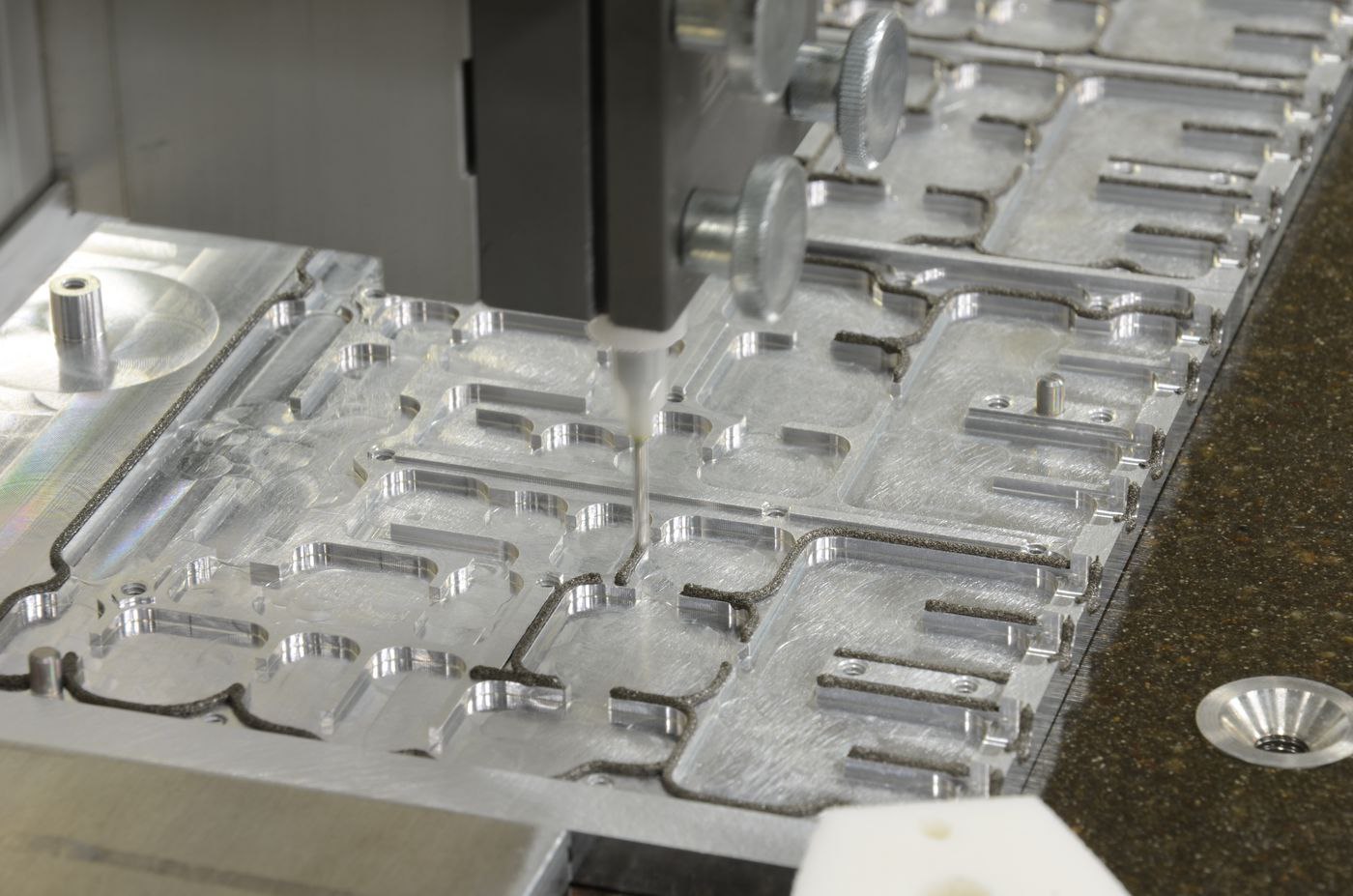
Form-in-place (FIP) gaskets provide precision sealing and EMI shielding for satellite communication components. The FIP process dispenses conductive or non-conductive elastomer beads directly onto metal housings, eliminating machined grooves and assembly alignment challenges.
FIP gaskets offer several advantages for satellite communication component manufacturing. The dispensing process creates gaskets that conform precisely to housing geometries, accommodating surface variations that might cause problems with die-cut gaskets. Adhesion to the housing surface eliminates the need for separate gasket retention features.
For small, complex, and intricate gasket geometries, FIP dispensing often proves more practical than alternative approaches. Gasket paths less than 1 mm wide are achievable with appropriate materials and dispensing equipment. Complex gasket routing around multiple internal compartments benefits from the flexibility FIP dispensing provides.
Standard FIP bead tolerance reaches ±0.15 mm (±0.006") for height dimensions. This precision enables reliable EMI shielding and environmental sealing in satellite communication applications. Width tolerances relate to height through material-specific ratios determined by the free-forming dispensing process.
Satellite communication components operate in extreme thermal environments. Temperature swings from -157°C (-250°F) in eclipse to 121°C (250°F) in direct sunlight stress materials and challenge thermal designs. Effective thermal management ensures reliable operation throughout multi-year missions.
Thermal interface materials (TIMs) bridge gaps between heat-generating components and heat sinks or radiating surfaces. These materials must maintain thermal conductivity across wide temperature ranges while accommodating mechanical tolerances in assembled systems.
Gap filler pads provide effective thermal interfaces for applications with varying gap dimensions. These conformable materials compress to fill spaces between mating surfaces, establishing thermal pathways that conduct heat away from sensitive electronics. Material selection considers thermal conductivity requirements, compression characteristics, and outgassing specifications for space applications.
Surface treatments enhance component performance in the demanding space environment. Platings improve electrical conductivity for RF applications. Conversion coatings provide corrosion protection. Thermal control coatings manage heat transfer. Each treatment type addresses specific functional requirements.
Coatings for space applications must meet ASTM E595 outgassing requirements. Materials that outgas in vacuum can contaminate sensitive optical surfaces or compromise electronic components. Space-qualified coatings undergo testing to verify acceptable mass loss and volatile condensable materials levels.
As technology advances, electronics and devices are shrinking in size to accommodate more complex project designs–simply put, they require more technology in less space. It pays to have a manufacturing part who is willing to push the boundaries.
Explore MaterialsConverting transforms raw elastomeric materials into precision components for satellite communication applications. Die cutting, waterjet cutting, and CNC knife cutting each offer distinct advantages depending on part geometry, material properties, and production requirements.
Learn how Modus has worked to create a long-term partnership with this DoD Telecommunications company.
See HowDefense satellite communication programs demand manufacturing partners with robust compliance infrastructure. Quality certifications demonstrate capability. Security certifications protect sensitive program information. Understanding these requirements helps engineers select appropriate manufacturing partners.
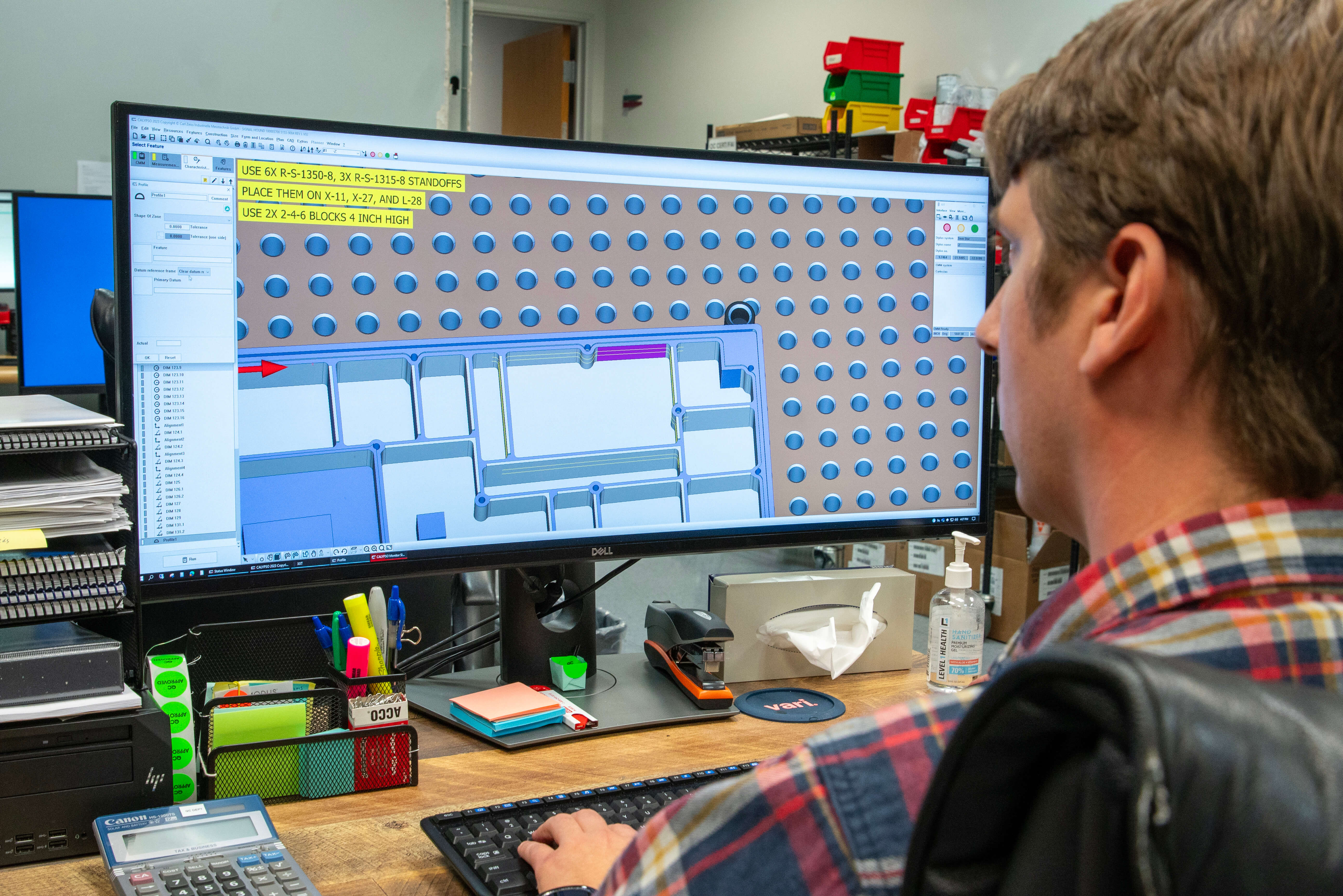
The Cybersecurity Maturity Model Certification (CMMC) framework protects Controlled Unclassified Information (CUI) in the defense industrial base. CMMC Level 2 certification requires implementation of 110 security practices aligned with NIST SP 800-171.
Manufacturers handling CUI for defense satellite programs must demonstrate CMMC compliance. This certification protects technical data, engineering drawings, and program information from unauthorized access. Manufacturing partners pursuing defense satellite work should already hold or be actively working toward CMMC certification.
International Traffic in Arms Regulations (ITAR) control the export of defense articles and services, including many satellite communication components. ITAR registration demonstrates authorization to handle controlled technical data.
Manufacturers producing components for defense satellite programs typically require ITAR registration. This registration protects controlled technical data throughout manufacturing processes. Engineering drawings, specifications, and manufacturing process information all fall under ITAR protection for controlled items.
Early manufacturing involvement during the design phase prevents costly issues later in development. Design for manufacturability (DFM) reviews identify opportunities to improve part performance while reducing manufacturing complexity and cost.
DFM feedback should reach design engineers while changes remain practical. Modifications late in the development cycle cost more and take longer than early design refinements. Manufacturing partners who engage early in the design process provide the most valuable DFM support.
Get a full breakdown of how the Design for Manufacturability Review process works at Modus.
DfM ProcessChoosing the right manufacturing partner impacts project success throughout the development cycle. Capability assessments, certification reviews, and cultural fit evaluations all contribute to informed partner selection.
Key evaluation criteria for satellite communication manufacturing partners include:
Modus Advanced provides precision component manufacturing for satellite communication applications. Our vertically integrated capabilities — CNC machining, RF shielding, FIP gasket dispensing, thermal management solutions, coatings, and converting — deliver complete solutions under one roof.
Our certifications demonstrate commitment to quality and security appropriate for defense and commercial space applications:
Engineers comprise more than 10% of our staff. This engineering depth enables responsive DFM support throughout your development cycle. Our team provides critical design feedback that prevents costly redesigns while ensuring your components perform as intended.
We engage early in the design process to optimize manufacturability. Our engineers understand how manufacturing process interactions affect final component performance. This integrated perspective helps identify opportunities that single-process vendors might miss.
Our vertically integrated approach consolidates manufacturing processes that traditional supply chains spread across multiple vendors. CNC machining, surface treatments, FIP gasket dispensing, and converting all happen under one roof. Benefits include:
Satellite communication systems connect warfighters in contested environments, enable emergency response coordination, and expand global connectivity. Your components serve missions where reliability matters and failure costs more than money.
We understand what’s at stake when your designs reach orbit. Our quality systems, engineering expertise, and manufacturing capabilities exist to ensure your satellite communication components perform flawlessly throughout their operational lives. Partner with us to bring your satellite communication innovations to production sooner — because one day matters.
Standard CNC machining tolerance is ±0.25 mm (±0.010"). FIP gasket dispensing achieves ±0.15 mm (±0.006") bead height tolerance. Converting tolerances range from ±0.25 mm (±0.010") to ±0.81 mm (±0.032") depending on material type and thickness. Tighter tolerances are achievable through specialized engineering solutions when mission requirements demand them, though this increases lead time and cost.

Modus Advanced holds AS9100 certification for aerospace quality management, ISO 9001 certification for quality systems, ITAR registration for controlled technical data, and CMMC Level 2 certification for cybersecurity practices. These certifications meet requirements for both defense and commercial satellite communication programs.
Vertical integration consolidates CNC machining, surface treatments, FIP gasket dispensing, and converting under one roof. This reduces lead times through concurrent processing, eliminates shipping between vendors, simplifies quality coordination with single-source responsibility, and prevents quality issues during hand-offs between multiple suppliers.
We machine aluminum (particularly 6061), steel alloys, copper alloys, and specialty aerospace metals. FIP gasket materials include silver-filled, nickel-filled, and graphite-filled conductive silicones from suppliers including Nolato, Parker Chomerics, and Laird. Thermal interface materials span the full range of gap fillers and phase change materials. All materials undergo evaluation for space environment compatibility.
We select materials meeting ASTM E595 outgassing requirements for space applications. Our manufacturing processes preserve material properties through controlled handling and processing. Quality systems include inspection and documentation practices meeting AS9100 requirements for aerospace applications. Engineering support helps identify space environment considerations during design reviews.
Yes. Our manufacturing capabilities support rapid prototyping for design validation through sustained production for ongoing programs. Different manufacturing methods optimize for different volume levels — CNC cutting and waterjet cutting provide quick-turn prototype capability while die cutting delivers production volume efficiency. We work with you to select appropriate processes as your program progresses through development phases.
Our engineers review your designs for manufacturability before production begins. We identify opportunities to improve component performance, reduce manufacturing complexity, and optimize costs. DFM feedback addresses wall thicknesses, feature accessibility, tolerance specifications, material selection, and process routing. Early engagement in your design cycle maximizes the value of DFM support.
We'll email you a downloadable PDF version of the guide and you can read it later.
Don’t take our word for it. Reach out and speak to one of our engineers about your part today and see the benefits for yourself. We strive to turn all quotes around 48 hours or less to get your part moving as quickly as possible.
Submit a Design