
Guide
Component Manufacturing for Unmanned Systems: From Group 1 Drones to Loyal Wingman
Download PDF![[hero] Drone guide](https://www.modusadvanced.com/hs-fs/hubfs/%5Bhero%5D%20Drone%20guide.png?width=1024&height=768&name=%5Bhero%5D%20Drone%20guide.png)
Table of Contents
Table of Contents
Key Points
- Unmanned systems span five DoD classification groups, each with distinct SWaP constraints, production volumes, and component requirements that demand manufacturing partners who understand the full spectrum
- EMI shielding, thermal management, and environmental sealing must be engineered together at miniaturized scale. Solutions that work for manned platforms rarely translate directly to Group 1–3 UAVs
- The DoD's Replicator initiative has made manufacturing speed and scalability a strategic requirement, not just a procurement preference
- CMMC Level 2, AS9100, and ITAR compliance are baseline requirements for defense drone supply chains. A single non-compliant supplier can disqualify an entire contract
- Vertically integrated manufacturing partners reduce supply chain complexity, protect CUI, and compress lead times at exactly the moment the defense industrial base needs all three simultaneously
Don't have time to read this? Take a copy with you:
Download PDF- 1The Unmanned Systems Moment
- 2The Unmanned Systems Landscape: DoD Group 1 Through Loyal Wingman
- 3Why UAV Component Manufacturing Is Different
- 4EMI Shielding for Unmanned Systems
- 5Thermal Management at SWaP Scale
- 6Environmental Sealing for Field-Deployed Platforms
- 7The Compliance Baseline: AS9100, ITAR, and CMMC for Defense Drone Suppliers
- 8What Components Do Drones and UAVs Need?
- 9Manufacturing Speed and Scale: The Replicator Imperative
- 10Frequently Asked Questions: Drone Component Manufacturing
- 11How Modus Advanced Supports Unmanned Systems Programs
- 12Download this Guide
- 1The Unmanned Systems Moment
- 2The Unmanned Systems Landscape: DoD Group 1 Through Loyal Wingman
- 3Why UAV Component Manufacturing Is Different
- 4EMI Shielding for Unmanned Systems
- 5Thermal Management at SWaP Scale
- 6Environmental Sealing for Field-Deployed Platforms
- 7The Compliance Baseline: AS9100, ITAR, and CMMC for Defense Drone Suppliers
- 8What Components Do Drones and UAVs Need?
- 9Manufacturing Speed and Scale: The Replicator Imperative
- 10Frequently Asked Questions: Drone Component Manufacturing
- 11How Modus Advanced Supports Unmanned Systems Programs
- 12Download this Guide
Table of Contents
Select Your Chapter
Chapter 1
The Unmanned Systems Moment
The DoD doesn't move fast. Acquisition cycles, qualification processes, and compliance requirements exist for good reasons. But unmanned systems have forced a reckoning with pace. From Group 1 hand-launched ISR platforms to Group 5 high-altitude long-endurance aircraft, and now to Loyal Wingman autonomous combat platforms, the demand signal is clear: the defense industrial base needs to manufacture more unmanned system components, faster, and at higher quality than it ever has before.
That pressure is real. The DoD's Replicator initiative, a multi-service effort to field thousands of attritable autonomous systems, put a number on it. Thousands of units. Not dozens. The components that go into those systems have to be manufactured at scale, at spec, and within supply chains that can withstand scrutiny at every level of the compliance stack.
This guide is built for the engineers and program managers who are actually solving that problem. It covers the unmanned systems landscape, the specific component manufacturing challenges these platforms create, and what a capable UAV manufacturing partner looks like when the mission demands more than an adequate vendor.
.jpg?width=1200&height=627&name=8%20RF%20Shielding%20Techniques%20to%20Know%20About%20(1).jpg)
Related
The Benefits of Vertical Integration
Find out how vertical integration can improve part quality and reduce lead times.
See HowChapter 2
The Unmanned Systems Landscape: DoD Group 1 Through Loyal Wingman
Understanding the drone component manufacturing challenge starts with understanding the platforms. The DoD classifies UAS into five groups based on weight, operating altitude, and airspeed. Those classifications carry enormous implications for how components are designed and produced.
Group 1–2: The Small Form Factor Problem
Group 1 UAS weigh less than 9 kg (20 lbs) and typically operate below 365 m (1,200 ft) AGL at speeds under 185 km/h (100 knots). Group 2 extends the weight ceiling to 25 kg (55 lbs). These are hand-launched, backpack-portable systems — the kind a squad leader deploys in minutes for over-the-ridge reconnaissance.
At this scale, every gram and every cubic centimeter is contested. SWaP (Size, Weight, and Power) governs every component decision. A thermal interface material that works fine in a crew-served sensor system may be completely unworkable in a Group 1 airframe where the entire electronics bay is smaller than a paperback book. EMI shielding that meets attenuation requirements but adds 15 grams is a real problem when the total payload budget is 250 grams.
Manufacturing tolerances have to hold at miniaturized dimensions, on materials that weren't originally designed for this application, in quantities that can range from prototype-scale to tens of thousands of units per year.
Group 3–4: The Mid-Tier Sweet Spot
Group 3 systems top out at 600 kg (1,320 lbs) and operate below 5,500 m (18,000 ft) MSL. Group 4 removes the altitude ceiling and extends the weight to anything above Group 3 that isn't a Group 5. This is where tactical UAS live: persistent ISR platforms, medium-altitude strike-capable UAVs, maritime patrol drones.
These platforms operate in contested electromagnetic environments by design. They carry sensitive electronics into RF-hostile spaces and need shielding that actually performs, not shielding that looked good on a benchtop test. Thermal loads are higher here, meaning more capable payloads, longer mission profiles, more heat to manage in a still-constrained airframe.
Manufacturing at this tier requires both precision and process repeatability. A form-in-place gasket that seals correctly on unit one has to seal correctly on unit five hundred. That's a process control problem, and it has to be solved before production begins.
Group 5 and Loyal Wingman: The High End
Group 5 covers large UAS — think MQ-9 class and above, operating above 5,500 m (18,000 ft) at high airspeeds. At this tier, UAV manufacturing requirements begin to converge with manned aircraft standards. AS9100 quality management is non-negotiable. Material traceability has to be rock solid. Lead times matter because these programs are expensive and any delay cascades across the program schedule.
The Loyal Wingman category covers autonomous or semi-autonomous combat aircraft designed to operate alongside manned platforms. These systems combine Group 5 size and capability with the attritable economics of Group 3, creating manufacturing demands that don't fit neatly into either bucket. They need to be producible at meaningful quantities, affordable enough to be expendable, and reliable enough to perform the mission. That combination doesn't tolerate sloppy manufacturing.
Counter-UAS: The Other Side of the Problem
cUAS — counter-unmanned aircraft systems — are the ground, air, and sea-based systems designed to detect, track, and defeat hostile drones. These platforms have their own component manufacturing requirements: hardened electronics for jamming systems, precision housings for directed energy emitters, thermal management for high-power RF systems, and environmental sealing for systems that operate in the field under fire.
cUAS component manufacturing often requires the same capabilities as UAV manufacturing, with additional emphasis on power handling and RF performance at frequencies that stress shielding materials differently than standard communications electronics.
Capabilities
Review all of Modus's Manufacturing Capabilities
See the full breadth of custom manufacturing services we can offer.
CapabilitiesChapter 3
Why UAV Component Manufacturing Is Different
Engineers who've spent their careers on manned platform programs understand precision manufacturing. What they encounter with unmanned systems, particularly Groups 1 through 3, often requires rethinking assumptions that worked fine in a larger envelope.
SWaP Changes Everything
The SWaP constraint is a design consideration and a manufacturing constraint. It determines which processes are viable at all. A bulkier gasket design that's straightforward to manufacture might be dimensionally acceptable for a Group 4 system but won't fit a Group 1 airframe. A thermal pad that's easy to handle and install at production scale might be too thick for the thermal stack in a miniaturized avionics bay.
This pushes converter-class manufacturing processes (die cutting, form-in-place gasket dispensing, precision conversion of thermal and RF materials) into territory that requires genuine engineering depth. Material selection, geometry, and manufacturing process interact in ways that can't always be anticipated from first principles. The manufacturing partner needs to have worked through enough of these problems to recognize when a proposed design is going to create a production issue downstream.
Attritability Changes the Volume Math
Attritable unmanned systems are designed to be expendable, and that's intentional. The strategic logic is that a system cheap enough to lose is worth risking in scenarios where a manned platform or expensive persistent asset cannot go.
But attritability creates a manufacturing challenge that's easy to underestimate: volume. When a platform is attritable, you need a lot of them. Every component in the bill of materials has to be manufacturable at scale, at cost, and without the kind of heroic effort that's acceptable for a low-rate initial production run of a complex manned aircraft.
Components that are hand-fitted, individually inspected by exception, or dependent on a single-source material become program risks at attritable scale. The manufacturing solution has to be repeatable by process, not by individual craftsperson skill.
Speed Is Now a Requirement
Replicator changed the vocabulary of defense procurement. The program's stated goal was to field multiple thousands of attritable autonomous systems within 18–24 months. Whether or not specific timelines held, the intent is clear: the defense industrial base has to respond at a pace that legacy acquisition cycles weren't designed for.
For drone component manufacturers, this means the quoting-to-production pipeline has to be short. Design-for-manufacturability review has to happen at the design stage, not after a drawing is already released. A partner who can return a quote in 48 hours and move to first article in days — not weeks — is genuinely valuable in a way that simply didn't exist five years ago.
Chapter 4
EMI Shielding for Unmanned Systems
Electromagnetic interference is a mission-critical problem for unmanned platforms. These systems operate in congested RF environments, often depend on radio links for command and control, and carry electronics sensitive to interference from both external sources and their own subsystems.
The Form-in-Place Advantage at Small Scale
Traditional cut-and-press gasket manufacturing works well at larger form factors. At Group 1 and Group 2 dimensions, it starts to break down. Gasket grooves get narrow, cross-sections shrink, and the tolerances required to maintain consistent compression force become difficult to achieve with stamped or molded parts.
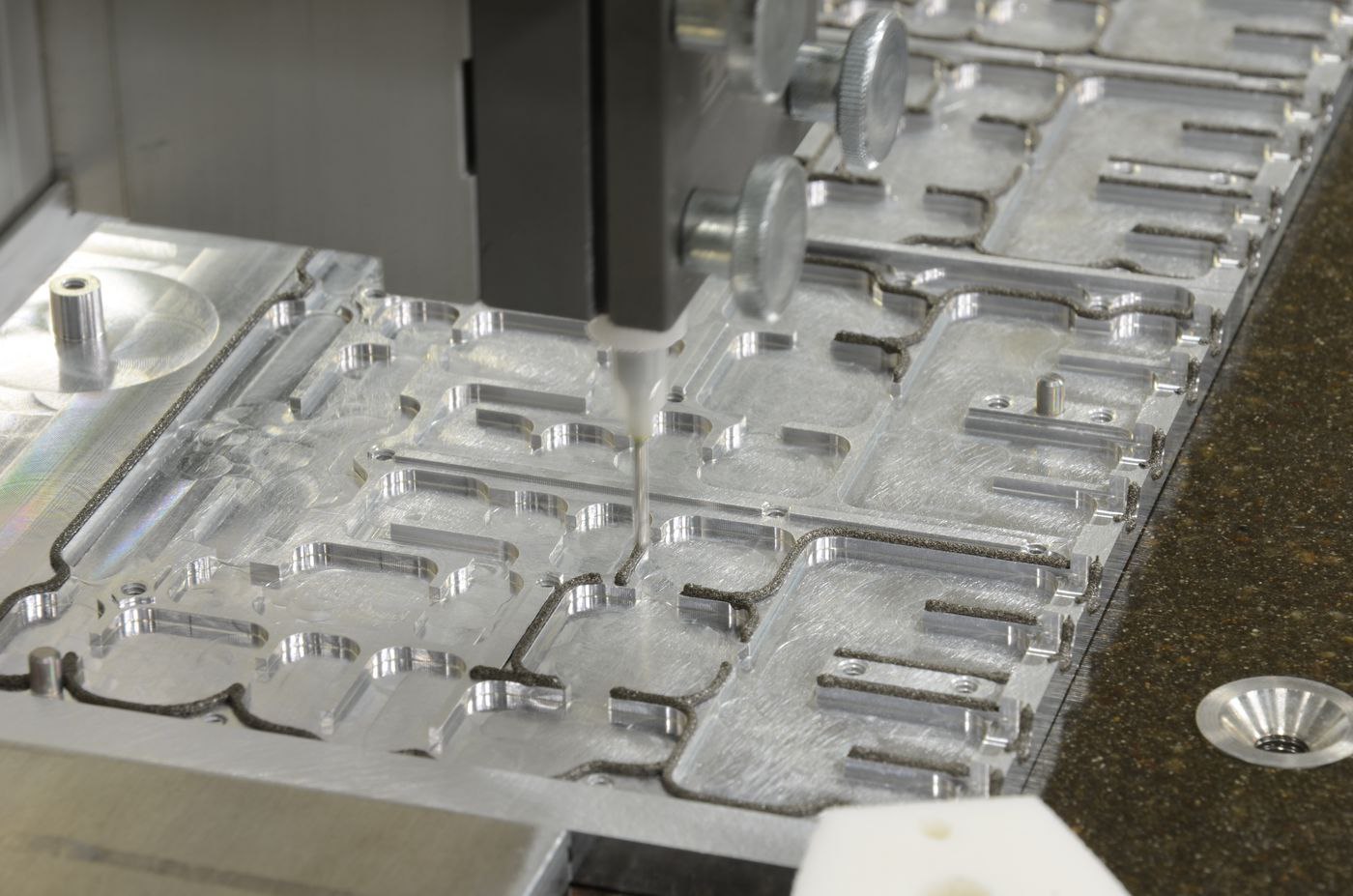
Form-in-place (FIP) gasket dispensing for ruggedized UAV communications addresses this directly. FIP applies conductive elastomer material — typically silicone-based with silver, silver-aluminum, or nickel-graphite particle fill — directly onto the housing using robotic dispensing equipment. The result is a gasket placed exactly where it needs to be, at a cross-section optimized for the groove geometry, with a consistency that stamped parts struggle to match at small scale.
For unmanned systems housings, FIP can hold bead height tolerances at ±0.15 mm (±0.006") under standard conditions. Start/stop zones introduce variability (typically -30% to +45% of nominal in a 3 mm window around initiation and termination points) which the housing groove geometry needs to account for in the design.
Shielding Materials for the Mission Environment
Not every conductive gasket material suits every unmanned platform. Selection depends on attenuation requirements across the relevant frequency range, the compression force the structure can accept, the chemical environment the platform operates in, and always the available cross-section.
Material System | Typical Use Case | Frequency Range | Key Consideration |
|---|---|---|---|
Silver-filled silicone | General-purpose EMI shielding | Broadband | Higher cost, excellent conductivity |
Silver-aluminum silicone | Cost-sensitive platforms with broad shielding needs | Broadband | Cost-performance balance |
Nickel-graphite silicone | Moderate shielding requirements | Mid-range | Lower cost, galvanic compatibility |
Copper-filled silicone | High-attenuation requirements | Broadband | Weight consideration at scale |
Fabric-over-foam | Low-compression force applications | Lower frequencies | Not recommended for small grooves |
The housing itself matters as much as the gasket. An FIP gasket dispensed onto an improperly plated or unplated aluminum housing won't perform to design intent regardless of the material system selected. Surface finish, conductivity, and plating choice — chromate conversion coating, electroless nickel, or other treatment — have to be selected in coordination with the gasket material, not independently.
RF Shield Housings: CNC Machining to FIP in One Supply Chain
The most efficient path to a shielded enclosure for an unmanned system is a single defense drone manufacturing partner who can machine the housing, apply the correct surface treatment, dispense the FIP gasket, and add any required absorber or thermal materials before shipping a finished sub-assembly. Modus Advanced's SigShield process does exactly that.
The alternative is separate vendors for machining, plating, and gasket application. That approach creates tolerance stack-up risk, increases lead time at every handoff, and multiplies the number of suppliers handling your controlled unclassified information. For a defense unmanned system, that's compliance exposure that doesn't need to exist.
Chapter 5
Thermal Management at SWaP Scale
Heat is the enemy of electronics reliability, and unmanned systems generate it in quantity. Avionics, power electronics, RF subsystems, and payload processors all produce heat in an airframe with minimal thermal mass and limited surface area for rejection. Managing that heat without adding unacceptable weight or volume is one of the harder engineering problems in Group 1–3 platform design.
Thermal Interface Materials: What Works and What Doesn't
Thermal interface materials (TIMs) fill the gap between a heat-generating component and its heat sink or chassis structure. Performance is measured primarily by thermal conductivity (W/m·K) and bond line thickness. The thinner the bond line, the lower the thermal resistance across the interface.
At SWaP scale, the manufacturing process for TIM application matters as much as material selection. A thermal pad that's 0.5 mm thick on a drawing becomes a problem if production variation allows it to run at 0.7 mm, because that 0.2 mm deviation represents real thermal resistance in a system with a tight junction temperature budget.
Die cutting TIMs to precise dimensions, and doing so with the consistency required for production quantities, demands process control that not every converter can deliver. Film materials at standard dimensions carry length and width tolerances of ±0.25 mm (±0.010") for dimensions under 25.4 mm (1.0"). At the thickness ranges typical for TIMs, this is achievable, but it has to be built into the process from the beginning.
Thermal Paths in Unmanned Airframes
The thermal architecture of an unmanned system defines what's possible from a component manufacturing standpoint. Conduction cooling through the chassis structure, heat pipes, vapor chambers, and active cooling loops each create different demands on the materials and geometries that have to be manufactured.
Chassis-conduction-cooled designs require tight contact between electronics cards and the chassis wall. The TIM in that interface has to be the right thickness, the right compliance, and the right conductivity. Gap filler materials, which are softer and self-conforming, can accommodate surface irregularities but require compression management to avoid overstressing components.
For Group 1 and Group 2 platforms where active cooling isn't an option, the thermal budget is non-negotiable. The component manufacturer's job is to deliver TIM-converted parts that hold tolerances tight enough that the thermal model stays valid in production units — not just in the development article that was individually shimmed and measured.
Chapter 6
Environmental Sealing for Field-Deployed Platforms
Unmanned systems operate in environments that manned aircraft mostly avoid: low-altitude dust and sand, maritime spray, jungle humidity, and rapid pressure cycling through descent profiles that legacy aircraft don't use. Environmental sealing is a primary reliability driver.
IP Rating vs. MIL-SPEC Sealing
Commercial UAVs often target IP67 or IP68 ratings. Defense unmanned systems typically operate under MIL-STD-810 test requirements, which address a broader set of environmental stressors including temperature extremes, humidity, vibration, shock, salt fog, and fungal resistance.
The sealing solution has to address both the ingress protection requirement and the mechanical environment. A gasket that seals against water intrusion but degrades under 200 hours of vibration at operational frequencies is not a sealing solution — it's a delayed failure.
Elastomeric Gasket Selection for Unmanned Systems
Gasket material choice depends on the chemical and thermal environment the platform will encounter. Silicone elastomers offer broad temperature performance (typically from -55°C to +200°C (-67°F to +392°F)) and good resistance to UV and ozone. They're the default for most airborne applications. EPDM offers better resistance to water and steam but poorer fuel and oil resistance. Fluorosilicone is the choice when fuel or hydraulic fluid exposure is a real possibility, at a cost premium.
For converted elastomeric gaskets, tolerance depends heavily on material category. A sponge or foam gasket under 6.3 mm (0.25") thick in the 25.4 mm to 160 mm (1.0" to 6.3") dimension range carries a standard tolerance of ±0.81 mm (±0.032"). A solid or dense elastomeric part in the same dimensional range holds ±0.63 mm (±0.025"). These are the standard starting points. Tighter tolerances are achievable through engineering solutions, but they increase cost and lead time and should only be specified when the sealing function genuinely requires it.
Sealing Strategy for Attritability
Attritable systems introduce a tension in sealing design. High-performance sealing solutions engineered for long service life are often overkill for a system intended to fly a limited number of missions before being consumed or retired. But an insufficiently robust sealing approach creates operational reliability problems that defeat the purpose of fielding the platform in the first place.
The right answer usually involves selecting a cost-appropriate material that meets the mission environmental requirement without over-engineering for longevity that will never be used. That's a conversation that benefits from a manufacturing partner who understands both the material options and the cost implications of each — because neither the design engineer nor the program manager can optimize that tradeoff alone.
True Partnership
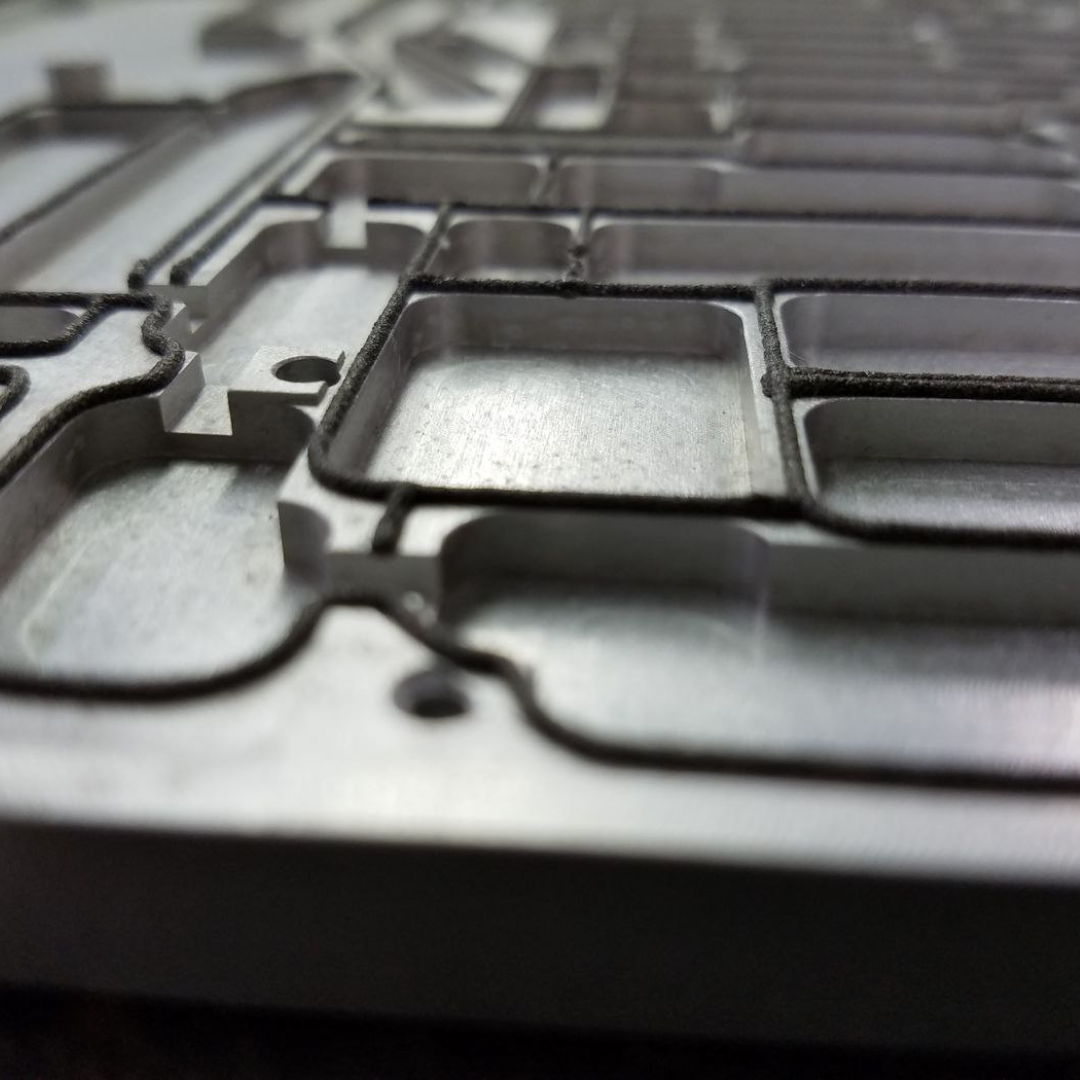
Small Bead FIP: Breaking the Bead Size Boundaries of Form-In-Place Gaskets
As technology advances, electronics and devices are shrinking in size to accommodate more complex project designs–simply put, they require more technology in less space. It pays to have a manufacturing part who is willing to push the boundaries.
Explore MaterialsChapter 7
The Compliance Baseline: AS9100, ITAR, and CMMC for Defense Drone Suppliers
Defense UAV programs have a compliance stack that exists for substantive reasons. These aren't bureaucratic obstacles — they're the mechanisms by which the government ensures that sensitive technical data stays protected, that quality systems are rigorous enough to catch problems before they become field failures, and that the supply chain can be audited and trusted.
Every drone component manufacturer supporting a defense UAV program needs to understand this compliance stack and demonstrate conformance, not just assert it.
AS9100: Quality Management That Actually Matters
AS9100 is the aerospace quality management system standard. It builds on ISO 9001 with additional requirements specific to aviation, space, and defense, including configuration management, risk management, and first-article inspection requirements that ISO 9001 alone doesn't mandate.
For unmanned systems, AS9100 certification at the component manufacturer level means the quality management system governing every part produced has been audited against the same standard that governs manned aircraft component production. That matters because the failure modes are real. A gasket that fails in service on a Group 4 ISR platform compromises the mission. A thermal interface that degrades early causes a processing failure that loses the system. Quality isn't optional, and a certified quality management system is the minimum evidence that the manufacturer takes it seriously.
Modus Advanced holds AS9100 certification. That certification isn't a marketing credential — it's evidence of a documented, audited quality system that governs how parts are produced, inspected, and shipped.
ITAR: Your Technical Data Doesn't Leave the Perimeter
The International Traffic in Arms Regulations govern the export of defense articles and services. For a drone component manufacturer, ITAR registration means the technical data on your defense UAV program — drawings, specifications, design files — is handled in compliance with export control law.
ITAR non-compliance at a supplier isn't just that supplier's problem. It's the prime contractor's problem, the program office's problem, and potentially a criminal liability problem. The compliance obligation flows down, and the risk flows up.
Modus Advanced maintains ITAR registration. Defense program technical data is handled in conformance with export control requirements at every stage of the manufacturing process.
CMMC Level 2: The New Baseline for UAV Programs Handling CUI
The Cybersecurity Maturity Model Certification program addresses a problem that ITAR registration alone doesn't fully solve: the cybersecurity of systems that handle Controlled Unclassified Information. CMMC Level 2 requires implementation of all 110 NIST SP 800-171 security controls and — critically — requires that compliance be validated by a third-party C3PAO assessment, not self-attested.
The CMMC Program final rule became effective December 16, 2024. Contract requirements began appearing in Q3 2025. A single non-compliant drone component manufacturer in your supply chain can disqualify an entire contract bid. This is not a hypothetical — it is the current operational reality of defense acquisition.
Modus Advanced holds CMMC Level 2 certification, assessed by an authorized C3PAO. All 110 NIST SP 800-171 controls are implemented across manufacturing operations, engineering systems, and business processes that handle defense technical data. Your drawings and specifications are protected from quote through delivery.
The Compliance Math of Vertical Integration
The compliance argument for vertical integration goes beyond efficiency. Every vendor in your supply chain who touches CUI is a compliance verification burden. If machining, gasket dispensing, plating, and material conversion are spread across four vendors, the prime contractor has to verify CMMC compliance at four separate organizations. If one of those organizations fails, the prime's contract risk materializes.
Consolidating those manufacturing steps under one CMMC-certified, AS9100-certified, ITAR-registered roof reduces both the compliance verification workload and the aggregate security exposure. That's a structural advantage that gets more valuable as CMMC enforcement tightens and defense subcontractor compliance requirements expand.
.png?width=1024&height=768&name=Telecommunciations%20(1).png)
Case Study
Redefining the Traditional Supplier Relationship to Create a 10 Year Partnership
Learn how Modus has worked to create a long-term partnership with this DoD Telecommunications company.
See HowChapter 8
What Components Do Drones and UAVs Need?
Engineers new to unmanned systems programs sometimes underestimate the component complexity. These are complex systems: dense integrations of electronics, structures, power systems, and sensors, all packaged into an airframe where every millimeter is accounted for.
Core Component Categories
The components that a precision converter and manufacturer addresses in a UAV program cluster into several functional areas, each with specific manufacturing requirements.
EMI shielding components: machined housings with FIP gaskets, die-cut absorber materials, and RF shielding films protect sensitive avionics and payloads from electromagnetic interference and prevent the platform's own emissions from creating interference with co-located systems.
Thermal management components: die-cut thermal interface pads, gap fillers, thermal gaskets, and in more capable platforms, components that support heat pipe or vapor chamber systems move heat away from electronics and out of the airframe.
Environmental sealing components: elastomeric gaskets (both die-cut and form-in-place) seal enclosure interfaces, connector boots, and access panels against moisture, dust, sand, salt fog, and pressure differential.
Structural and acoustic components: vibration isolation for sensitive sensors, acoustic dampening in platforms where motor and propeller noise creates sensor interference, and structural foam components in composite airframe assemblies.
Antenna and RF performance components: absorber materials that reduce multipath and manage RF within the platform, radomes manufactured to maintain transparency across the required frequency range, and ground plane materials that support communications, navigation, and sensor functions.
The Integration Challenge
None of these component categories exists in isolation. An EMI shield housing needs a thermal management strategy because the electronics inside generate heat and the housing has to get that heat out. The sealing strategy for that housing has to be compatible with the FIP gasket material and the surface treatment on the housing flange. The absorber materials inside the housing have to fit within the available volume after thermal and shielding requirements are satisfied.
This integration is where engineering depth at the manufacturer level pays off. A supplier who can only manufacture the part you've drawn — without engaging on whether the design can be improved or whether the interactions between components will create problems — is a parts source. A manufacturing partner who has solved these integration challenges before is something more useful.
Chapter 9
Manufacturing Speed and Scale: The Replicator Imperative
MIL-STD-461 is the foundational standard that most RF engineers will work against directly. It defines conducted and radiated emissions and susceptibility limits across the frequency range of interest. MIL-STD-464 extends these requirements to the integrated platform level, addressing how multiple systems interact electromagnetically when installed together. For a deeper look at how these standards translate into manufacturing requirements, see our companion article on RF shielding for missile defense manufacturing compliance.
Shielding Effectiveness Testing
SE testing is typically performed per IEEE 299 or equivalent methods. This testing is especially critical for radar EMI shielding applications where even modest leakage can degrade receiver sensitivity. The test measures the attenuation of electromagnetic fields across the frequency range of interest, comparing field strength measurements with and without the shielded enclosure in place.
Test results are only as good as the test setup. Gasket compression, cover fastener torque, connector tightness, and cable shield terminations all affect measured SE. The test configuration must match the as-installed configuration of the shielding assembly. A shield that tests well on the bench can fail in the field if the gaskets are under-compressed or the fastener pattern is different from the test fixture.
Environmental Qualification
Shielding assemblies must maintain their SE performance after exposure to the full range of environmental stresses specified in the system's environmental qualification program. The following table summarizes the key environmental tests and their relevance to RF shielding integrity.
Shielding assemblies must maintain their SE performance after exposure to the full range of environmental stresses specified in the system's environmental qualification program. The following table summarizes the key environmental tests and their relevance to RF shielding integrity.
Environmental Test | MIL-STD-810 Method | Typical Conditions | Shielding Impact |
Temperature cycling | Method 503 | –55°C to 85°C (–67°F to 185°F) storage | Gasket compression set, adhesion degradation |
Random vibration | Method 514 | Transportation, captive carry, powered flight profiles | Gasket fretting, contact pressure loss |
Mechanical shock | Method 516 | Handling drops, pyrotechnic events, stage separation | Housing deformation, gasket displacement |
Humidity | Method 507 | Sustained high-humidity exposure | Gasket conductivity degradation, corrosion |
Salt fog | Method 509 | Accelerated corrosion testing | Interface corrosion, particularly for naval systems |
Specific temperature and vibration profiles vary by program. Naval missile defense systems will emphasize salt fog and humidity testing, while air-launched systems will see more demanding vibration and shock profiles. Ground-based radar platforms face their own unique environmental challenges — see our guide to environmental sealing for ground-based radar equipment for more on that topic. The key is verifying SE both before and after the complete sequence of environmental exposures — not after individual tests alone.
The gasket is often the weakest link in shielding performance after environmental exposure. Compression set, adhesion degradation, and corrosion at the gasket-housing interface are the most common failure mechanisms. Selecting the right gasket material and specifying appropriate surface treatments on the housing are the best ways to prevent these failures.

Related
What Happens During a DfM Review?
Get a full breakdown of how the Design for Manufacturability Review process works at Modus.
DfM ProcessChapter 10
Frequently Asked Questions: Drone Component Manufacturing
Defense engineers and procurement teams consistently ask the same questions when qualifying a drone component manufacturing partner. The answers below are written to stand on their own.
What certifications does a defense drone component supplier need?
Defense drone component suppliers need a minimum of three certifications: AS9100 for aerospace quality management, ITAR registration for handling defense technical data, and CMMC Level 2 certification for cybersecurity compliance when handling Controlled Unclassified Information. AS9100 ensures the quality management system has been audited against aviation, space, and defense requirements. ITAR registration ensures export control compliance for drawings and specifications. CMMC Level 2 — validated by a third-party C3PAO, not self-attested — confirms that all 110 NIST SP 800-171 security controls are implemented. As of Q3 2025, CMMC requirements are appearing in defense contracts, and a single non-compliant supplier can disqualify an entire prime contractor bid.
What is CMMC Level 2 and why does it matter for UAV programs?
CMMC Level 2 is the cybersecurity standard required for defense contractors and subcontractors who handle Controlled Unclassified Information. It requires implementation of all 110 security controls defined in NIST SP 800-171 and mandates third-party assessment by an authorized C3PAO — self-attestation is not sufficient. For UAV programs, CMMC Level 2 matters because technical drawings, specifications, and design files shared with manufacturing partners constitute CUI. Any supplier in the chain who lacks CMMC Level 2 certification creates contract risk for the prime. The CMMC Program final rule became effective December 16, 2024, and contract enforcement began in Q3 2025.
How is EMI shielding applied in military drone housings?
EMI shielding in military drone housings is typically achieved through a combination of conductive housing material (usually 6061 aluminum), surface treatment (chromate conversion coating or electroless nickel), and a conductive elastomeric gasket at every enclosure interface. For Group 1–3 UAVs where form factor is highly constrained, form-in-place (FIP) gasket dispensing is the preferred approach. FIP applies conductive silicone elastomer — filled with silver, silver-aluminum, or nickel-graphite particles — directly onto the housing flange via robotic dispensing. FIP maintains bead height tolerances of ±0.15 mm (±0.006") under standard conditions and accommodates complex groove geometries that stamped gaskets cannot reliably fill at small scale. Absorber materials placed inside the housing manage internal reflections and reduce multipath.
What manufacturing processes produce precision drone components?
Precision drone components require a combination of manufacturing processes: CNC machining for metal housings and enclosures (tolerances from ±0.025 mm to ±0.127 mm / ±0.001" to ±0.005"), form-in-place gasket dispensing for EMI and environmental sealing, die cutting and waterjet cutting for thermal interface materials and RF absorbers, and plating and coating for surface treatment. The most efficient and compliance-friendly approach routes all of these steps through a single vertically integrated manufacturer operating under a unified CMMC Level 2 certified environment — eliminating tolerance stack-up at handoffs, reducing CUI exposure, and compressing lead time.
What is the DoD UAV Group classification system?
The DoD classifies unmanned aerial systems into five groups based on weight, operating altitude, and airspeed. Group 1 covers systems under 9 kg (20 lbs) operating below 365 m (1,200 ft) AGL at under 185 km/h (100 knots). Group 2 extends to 25 kg (55 lbs). Group 3 covers systems up to 600 kg (1,320 lbs) operating below 5,500 m (18,000 ft) MSL. Group 4 removes the altitude ceiling for heavier systems. Group 5 covers large UAS above 5,500 m (18,000 ft) at high airspeeds. Each group carries distinct SWaP constraints, production volume expectations, and component manufacturing requirements. Groups 1–3 impose the most demanding miniaturization and weight constraints. Groups 4–5 converge with manned aircraft manufacturing standards.
How does vertical integration reduce supply chain risk in defense drone programs?
Vertical integration reduces supply chain risk in defense drone programs in two distinct ways. First, it reduces compliance exposure: fewer vendors handling CUI means fewer CMMC audits to manage and fewer potential points of non-compliance. Second, it reduces schedule risk: when machining, FIP dispensing, plating, and material conversion happen under one roof, lead times don't stack across multiple vendor queues and program managers don't coordinate across separate supplier schedules. For drone programs operating under Replicator-era timelines, both benefits are operationally significant.
What materials are used in military UAV housings and enclosures?
Military UAV housings are most commonly machined from 6061 aluminum alloy, which offers the best combination of strength-to-weight ratio, machinability, and compatibility with the surface treatments required for EMI shielding effectiveness. Chromate conversion coating (Alodine) and electroless nickel plating are the standard surface treatments for conductive interfaces. Structural composite materials are used in airframe assemblies where weight savings justify the manufacturing complexity. Thermal interface materials — typically silicone-based gap fillers or phase-change pads — are used at electronics interfaces. Elastomeric gaskets (silicone, EPDM, or fluorosilicone depending on chemical environment) provide environmental sealing at enclosure interfaces.
Chapter 11
How Modus Advanced Supports Unmanned Systems Programs
Modus Advanced is a vertically integrated precision manufacturer with deep experience in defense unmanned systems component production spanning UAV payload integration. Our capabilities span the full component stack that UAV programs require: CNC machining for metal housings and enclosures, form-in-place gasket dispensing for EMI shielding and environmental sealing, die cutting and waterjet cutting for thermal and RF materials, plating and coatings for surface treatment, and assembly of complete sub-assemblies delivered ready for system integration.
Engineers make up more than 10% of our staff. That's a structural choice that reflects what our defense partners need from us. When you bring a design to Modus, you're working with engineers who understand SWaP constraints, who have dispensed FIP gaskets onto small-form-factor housings before, and who can tell you whether your groove geometry will produce a consistent seal at production volume before you've committed to a tooling design.
Our SigShield process delivers turnkey RF shield sub-assemblies — machined housing, surface treatment, FIP gasket, absorber materials, and thermal components — all under one roof, all within our CMMC Level 2 certified environment. For a UAV program where the RF shield is a critical component and supply chain complexity is a schedule risk, SigShield eliminates the coordination problem at the source.
Our compliance stack — CMMC Level 2 (C3PAO assessed), AS9100, ISO 9001, and ITAR — covers the requirements that defense UAV programs impose on their supply chains. We provide certification documentation for supplier qualification reviews and maintain our certifications continuously, not as point-in-time snapshots.
We quote in 48 hours or less on most programs. DFM feedback comes with the quote, not as a separate engagement that adds weeks to the front end of a program. When you need to move fast — and Replicator-era unmanned systems programs need to move fast — the front-end timeline matters as much as the production timeline.
The service member in the field depending on that platform's sensor feed, the pilot whose wingman is autonomous, the mission that doesn't get a second chance — none of them have margin for component failures. Because failure isn't an option here.
Let's solve this together. Submit your design at modusadvanced.com or reach out to our engineering team directly. One day matters.
Don't have time to read the entire guide now?
We'll email you a downloadable PDF version of the guide and you can read it later.
Get Started
Speak to an Engineer Today
Don’t take our word for it. Reach out and speak to one of our engineers about your part today and see the benefits for yourself. We strive to turn all quotes around 48 hours or less to get your part moving as quickly as possible.
Submit a Design