Three Processes, One Part: Choosing the Right Conductive Silicone Cutting Method
Die cutting vs. waterjet cutting vs. CNC knife cutting — for conductive silicone applications, the choice between these three processes is one of the most consequential early decisions on a program. Get it right and you get accurate parts on time. Get it wrong and you get deformed edges, scrapped material, tolerance failures, or a tooling investment for a process that can't actually make the part.
Conductive silicone is a broad material category. It includes dense rubber sheets filled with silver or nickel for EMI shielding, soft putty compounds filled with aluminum or copper for thermal management, and various foam-based formulations for combined cushioning and shielding applications. Each of these material types behaves differently under a cutting tool, and that behavior largely determines which manufacturing process is appropriate.
This guide walks through the three primary cutting processes used for conductive silicone components at Modus Advanced — die cutting, waterjet cutting, and CNC knife cutting — and provides the decision framework engineers need to select the right fit for their application.
Essential Background Reading:
- EMI & RF Shielding at Modus: How conductive silicone converting fits into broader EMI/RF shielding solutions — materials, process options, and shielding effectiveness considerations.
- Thermal Management Applications: Where thermal interface material cutting fits in the broader thermal management capability set — and why TIM material type is the first process selection filter.
- Complete Guide to Gasket Materials: Technical breakdown of conductive silicone material categories — solid rubber, putty, and foam — with filler options and properties that drive process selection decisions.
Die Cutting: The High-Volume Standard for Stable Conductive Rubbers
Die cutting is the workhorse of the elastomeric converting industry. A shaped steel-rule die — essentially a precision cookie cutter — is pressed into sheet material under hydraulic force, stamping out the desired geometry. It's fast, repeatable, and cost-effective at volume.
For solid or dense conductive silicone rubbers (BL2 designation), die cutting is often the process of choice when volumes justify the tooling investment and part geometry is compatible with the process constraints.
When Die Cutting Is the Right Choice
Die cutting works best when several conditions are true simultaneously. Part geometry should be relatively simple, without extremely narrow walls or intricate interior features. The material needs to be dimensionally stable enough to resist deformation under press force. And the program requires production volumes where the fixed tooling cost amortizes to an acceptable unit cost.
The following conditions favor die cutting for conductive silicone applications:
- Production volume: Die tooling typically carries a lead time of one to two weeks. For prototype quantities, that tooling cost-to-part ratio is hard to justify — but for production runs, it drives unit cost down significantly.
- Simple geometry: Parts without walls narrower than the material can support under press force are good candidates.
- Dimensionally stable material: Solid rubber and dense conductive silicone sheets handle the compression and release cycle of die cutting without permanent deformation.
- Standard part sizes: Parts that fit within the die press bed — typically up to roughly 610 mm × 610 mm (24" × 24") depending on the press — are appropriate for this process.
Die Cutting Tolerance Expectations
For solid or dense conductive silicone materials (BL2 designation), standard die cutting tolerances are ±0.38 mm (±0.015") for features under 25 mm (1.0") in dimension, and ±0.63 mm (±0.025") for features in the 25 mm – 160 mm (1.0" – 6.3") range.
Tighter tolerances are achievable with precision tooling and fixturing, but this adds lead time and cost. Tolerances should only be tighter than standard if your design or functional requirements genuinely demand it — not simply because the drawing defaulted to a blanket callout.
Where Die Cutting Breaks Down
Die cutting has real limits. Very thin walls — features in the sub-1.0 mm range — are at risk of the blade breaking through before it completes the cut. The press force distributes across the die perimeter and if a wall is too narrow, the material collapses rather than shears cleanly.
Putty-based thermal interface materials are categorically incompatible with die cutting. The press force deforms the edges before the blade cuts through, producing parts that are out-of-tolerance and unusable. No amount of tooling optimization resolves this — it's a material physics problem, not a process optimization problem.
Waterjet Cutting: Precision Geometry for Conductive Silicone Without Hard Tooling
Waterjet cutting uses a high-pressure stream of water — operating at pressures up to 414 MPa (60,000 psi) — to cut through materials with no heat-affected zone and no hard tooling requirement. Parts are cut from a digital file, which means geometry changes are software changes, not tooling changes.
For conductive silicone rubbers, waterjet cutting is an excellent solution for complex geometry, large-format parts, and programs that need parts quickly without the tooling lead time of die cutting.
When Waterjet Cutting Is the Right Choice
Waterjet cutting is frequently the best process when one or more of the following conditions apply:
- Complex geometry: Waterjet produces the most precise interior corners of any cutting process, making it ideal for intricate shapes that die tooling cannot replicate cost-effectively.
- Large-format parts: The waterjet cutting bed accommodates large parts with high accuracy, and efficient part nesting reduces material waste — a meaningful cost driver for expensive conductive silicone stock.
- Short lead time requirements: No hard tooling means parts can often be turned around in days rather than weeks.
- Low-to-medium volumes: The economics favor waterjet for programs that haven't yet reached the volume threshold where die cutting amortizes well.
- Thick or high-durometer materials: Waterjet handles harder, thicker materials better than knife-based cutting processes.
Waterjet Cutting Tolerance Expectations
Waterjet cutting for solid conductive silicone (BL2 designation) achieves the same standard tolerance ranges as die cutting: ±0.38 mm (±0.015") under 25 mm (1.0") and ±0.63 mm (±0.025") in the 25 mm – 160 mm (1.0" – 6.3") range. For film materials (BL1 designation), waterjet can achieve ±0.25 mm (±0.010") for features under 25 mm (1.0").
The Hard Rule: Waterjet Cutting and Thermal Putty Don't Mix
Waterjet cutting is categorically incompatible with putty-based thermal interface materials. The process introduces water to a material that is actively degraded by moisture exposure. The high-pressure stream doesn't just wet the surface — it can penetrate the material and alter its thermal and mechanical properties. This is not a borderline tradeoff; water exposure ruins the material.
For any thermal putty application, waterjet is off the table. Full stop.
CNC Knife Cutting: The Most Versatile Process for Conductive Silicone
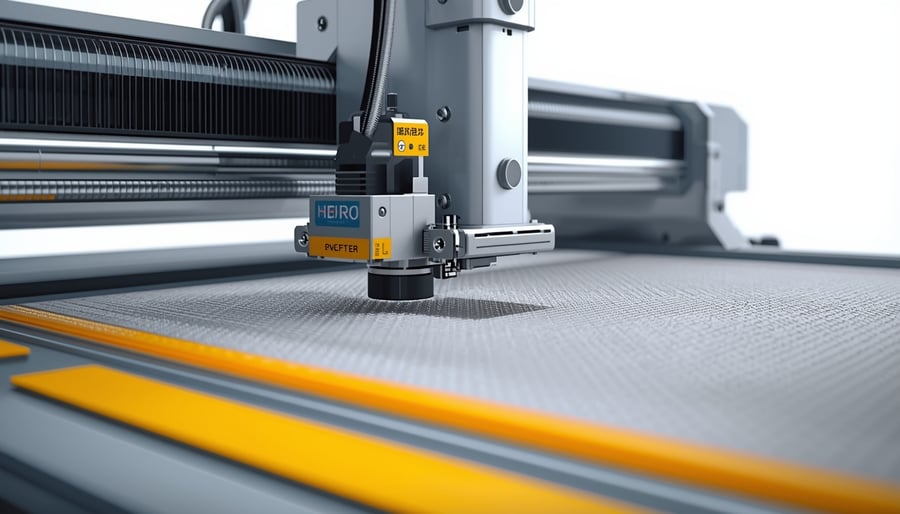
CNC knife cutting uses a computer-controlled blade to cut parts from sheet material following a digitally programmed toolpath. The blade applies minimal lateral force to the surrounding material, which is what makes it suitable for materials and geometries that die cutting and waterjet cannot handle.
CNC cutting is the most versatile process available for conductive silicone applications. It handles putty materials, thin-wall geometries, prototype volumes, and production runs without requiring hard tooling.
When CNC Knife Cutting Is the Right Choice
CNC knife cutting is the preferred process when the following conditions apply:
- Putty-based TIMs: This is the only viable cutting process for thermally conductive putty materials. There is no alternative.
- Thin-wall geometries: Wall features in the sub-1.0 mm range that would break through under die press force can often be successfully cut on the Zund with appropriate toolpath sequencing.
- Rapid prototyping: No hard tooling means parts can be produced quickly, and geometry changes are implemented in software with no tooling cost.
- Mixed material programs: When a program requires cutting both stable rubbers and more sensitive materials in the same production run, the Zund handles the full material range.
- Irregular or intricate geometries: Complex shapes that would require expensive or fragile die tooling are straightforward for CNC knife cutting.
How Toolpath Sequencing Solves Thin-Wall Problems
One of the less obvious advantages of CNC knife cutting is the ability to control the sequence in which features are cut. For parts with very thin walls — features at or near the 0.51 mm (0.020") range — the cutting sequence can be programmed to leave the most structurally vulnerable features until last. Surrounding material provides support while the more robust features are cut first, and the thin walls are completed with the part otherwise fully supported.
This approach allows production of parts that would be physically impossible to die cut. It requires engineering judgment in the programming phase — which is precisely why working with a manufacturing partner that employs engineers in the production environment matters.
CNC Knife Cutting Tolerance Expectations
CNC knife cutting for solid conductive silicone (BL2 designation) achieves standard tolerances of ±0.38 mm (±0.015") for features under 25 mm (1.0"). For film materials (BL1 designation) under 25 mm (1.0"), tolerances of ±0.25 mm (±0.010") are achievable at standard conditions.
Tighter tolerances require additional fixturing, toolpath optimization, and slower cycle times. This is achievable through creative engineering, but it increases both lead time and cost. Tolerances should only be tightened beyond standard when the functional requirements of the design actually demand it.
Related Content:
- Is Die Cutting the Right Fit for Your Custom Gasket? The detailed breakdown of when die cutting's economics work — and the geometry and material constraints that make it the wrong call.
- Waterjet Cutting for Custom Gaskets: When waterjet is the right process for complex corner geometry and thick materials — and why moisture sensitivity is the hard stop for putty-based applications.
- Is Digital or CNC Cutting the Right Fit for Your Custom Gasket? How to evaluate CNC knife cutting for your specific material and geometry — the considerations that determine when digital cutting is the optimal process.
- Digital Cutting Tolerances: Achievable tolerance ranges for CNC knife cutting by material designation — the reference for right-sizing specs when using the tolerance band technique.
Conductive Silicone Cutting Process Selection: Decision Matrix
Selecting the right cutting process for a conductive silicone application requires matching material type, geometry, and program requirements to process capabilities. The following table provides a summary decision framework.
Condition | Die Cutting | Waterjet Cutting | CNC Knife |
Solid/dense conductive rubber (BL2) | ✓ Good fit | ✓ Good fit | ✓ Good fit |
Putty-based thermal interface material | ✗ Not viable | ✗ Not viable | ✓ Required |
Foam conductive material (BL3) | ✓ (moderate thickness) | ✓ Good fit | ✓ Good fit |
Thin walls ≤ 1.0 mm (0.040") | ✗ Risk of breakthrough | ✓ Possible | ✓ Preferred |
Large format (> 610 mm / 24") | ✗ Press size limited | ✓ Good fit | ✓ Good fit |
Complex interior geometry | Limited | ✓ Best corners | ✓ Good fit |
Prototype / low volume | Limited (tooling cost) | ✓ No tooling | ✓ No tooling |
High production volume | ✓ Best unit cost | ✓ Viable | ✓ Viable |
Short lead time | ✗ Tooling lead time | ✓ Quick turn | ✓ Quick turn |
Moisture-sensitive materials | ✓ Dry process | ✗ Not viable | ✓ Dry process |
Using Tolerances to Your Advantage in Conductive Silicone Design
One of the more underutilized tools in design for manufacturability (DFM) is the tolerance band itself. When a feature is close to the edge of what a process can produce, the stated tolerance on the drawing can sometimes be used to shift the nominal dimension in a direction that makes the part manufacturable — while keeping the final part within the original design intent.
If a conductive silicone part has a wall feature that's barely achievable at the nominal dimension, widening the nominal by the amount of tolerance available may bring the feature into reliable production territory without any functional compromise. This requires open communication between the engineer and the manufacturing partner — which is exactly the kind of DFM conversation that avoids rework and schedule delays.
Next Steps:
- Submit Your Design for Process Review: Get Modus Advanced engineering input on the right cutting process for your conductive silicone application — before a wrong process selection costs you time and material.
- Custom Gasket Manufacturing Resource Center: All of Modus Advanced's custom gasket resources in one place — material guides, process articles, and design references from prototype through production.
- How to Choose the Right Custom Gasket Company for Critical Applications: Process selection capability is one item on the evaluation list — here's the full picture of what a qualified converting partner brings to mission-critical programs.
- DFM — Optimizing Converted Parts and Custom Gaskets for Modern Manufacturing: How DFM principles apply to elastomeric converting — the design decisions that determine which cutting process is even viable for your part.
Frequently Asked Questions: Conductive Silicone Cutting Processes
Can you waterjet cut thermal putty?
No. Waterjet cutting is categorically incompatible with putty-based thermal interface materials. The high-pressure water stream degrades the material by altering its thermal and mechanical properties through moisture absorption. CNC knife cutting is the only viable process for cutting thermally conductive putty materials.
What is the minimum wall thickness achievable in die-cut conductive silicone?
Die cutting becomes unreliable for wall features in the sub-1.0 mm range. The press force distributes across the die perimeter, causing narrow walls to collapse rather than shear cleanly. For thin-wall features at or near 0.51 mm (0.020"), CNC knife cutting with engineered toolpath sequencing is the preferred process.
What tolerance can I expect from die cutting conductive silicone?
Standard die cutting tolerances for solid or dense conductive silicone (BL2 designation) are ±0.38 mm (±0.015") for features under 25 mm (1.0") and ±0.63 mm (±0.025") for features in the 25 mm – 160 mm (1.0" – 6.3") range. Tighter tolerances are achievable with precision tooling but add lead time and cost.
When should I choose CNC knife cutting over waterjet for silicone EMI pads?
CNC knife cutting is required when the material is putty-based or moisture-sensitive. It's also preferred for thin-wall features below 1.0 mm and for rapid prototyping where no hard tooling is desired. Waterjet cutting is better suited for very complex interior corner geometry or thick, high-durometer materials where moisture exposure is not a concern.
Does die cutting require tooling lead time for conductive silicone parts?
Yes. Die tooling typically carries a lead time of one to two weeks. This makes die cutting less economical for prototype quantities but highly cost-effective for production runs where the fixed tooling cost amortizes well across large volumes.
See It In Action:
- Space-Critical Components: Engineering a Custom Converting Process: How Modus Advanced engineered a custom waterjet cutting approach — with lead-in/lead-out strategies and adhesive bonding techniques — to achieve tolerances that a standard process couldn't hit.
- Small Bead FIP: When Standard Process Limits Aren't Enough: Engineering a solution for a feature size below material manufacturer specs — the same process-first engineering mindset applied to every conductive silicone cutting decision.
- RF Shielding Case Study — Signal Hound: How vertically integrated conductive silicone converting — all under one roof with a single quality system — eliminated the coordination risk of multi-vendor shield assembly.
Modus Advanced: Engineering the Right Conductive Silicone Cutting Process for Your Application
Process selection for conductive silicone isn't a lookup table problem — it's an engineering judgment call that depends on material properties, geometry, volume, timeline, and budget. Getting it wrong costs time and material. Getting it right is what separates a manufacturing partner from a job shop.
Modus Advanced operates die cutting, waterjet cutting, and CNC knife cutting processes under one roof, supported by an engineering team that makes up more than 10% of our total staff. We engage directly in DFM reviews to help engineers select the right process before parts go into production — not after the first article fails inspection.
Our certifications include AS9100, ISO 9001, and ITAR compliance, and we support partners from prototype through production with quote turnarounds in 48 hours or less. Whether your application calls for a high-volume die cut EMI pad, a complex waterjet-cut gasket geometry, or a putty TIM that only the CNC cutting can handle — we have the process, the tooling, and the engineers to get it right.
When your electronics are flying, the shielding and thermal management behind them has to work. Partner with a team that knows how to manufacture the parts that keep them running — because one day matters.