.png?width=900&name=Defense%20CNC%20Machining%20Precision%20Tolerances%20and%20CMMC%20Compliance%20in%20Manufacturing%20(1).png)
What Defense Engineers Need in a CNC Machining Partner
Defense CNC machining for military applications presents unique challenges that standard CNC job shops aren't equipped to handle. You're not just buying machined parts—you're selecting a partner who will protect your intellectual property, meet stringent quality standards, and deliver on time despite the operational complexity that security requirements create.
The right defense manufacturing partner understands that ±0.25 mm (±0.010") tolerances aren't optional suggestions. They're mission-critical specifications that ensure your systems perform reliably when service members depend on them. But precision alone isn't enough for defense contractors. Your partner also needs the security infrastructure, quality systems, and operational discipline that defense work demands.
This article examines what to look for when selecting a CNC machining partner for defense applications. We'll explore how CMMC compliance requirements affect manufacturing operations, what questions to ask potential partners, and how to identify shops that can deliver both security and quality without compromising your project timeline.
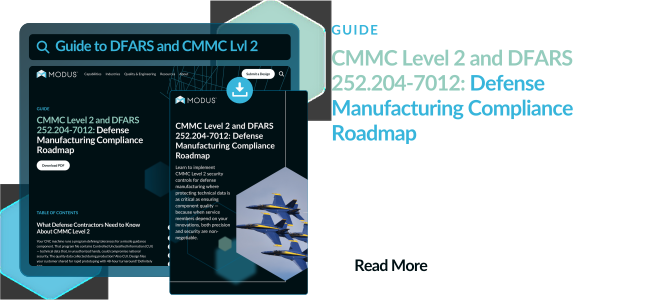
Read the guide to CMMC Level 2 and DFARS 252.204-7012
Understanding CMMC: The Defense Industry's Cybersecurity Standard
The Cybersecurity Maturity Model Certification (CMMC) framework has fundamentally altered defense supply chains. CMMC is the Department of Defense's unified standard for implementing cybersecurity across the defense industrial base, which includes more than 300,000 companies. Understanding how CMMC Level 2 and DFARS 252.204-7012 requirements create a comprehensive compliance roadmap for defense manufacturers is essential when evaluating potential manufacturing partners, as CMMC compliance requires manufacturers to implement comprehensive cybersecurity controls that protect Controlled Unclassified Information (CUI) throughout production.
For engineers selecting manufacturing partners, this creates new evaluation criteria. A shop with excellent CNC capabilities but inadequate cybersecurity infrastructure can't take on your defense work, regardless of their technical expertise. Conversely, a CMMC-certified shop that lacks engineering support or struggles with tight tolerances won't deliver the results your project requires.
The operational reality of CMMC compliance affects every aspect of defense CNC machining. CAM software must operate on secure networks with access controls. Machine operators need security clearances and training. Parts require secure storage between operations. Every data transfer and file access generates audit trails that must be maintained.
These requirements create genuine operational overhead. The question isn't whether a manufacturing partner has CMMC certification—that's table stakes. The question is whether they've built their operations to handle this overhead efficiently or whether compliance slows their production to a crawl.
How Security Requirements Impact CNC Manufacturing Operations
Understanding the operational impact of security requirements helps you evaluate whether a potential manufacturing partner can actually deliver on their promises. Shops that treat CMMC as a checklist exercise often struggle when real production begins.
Consider the practical realities of defense manufacturing. Your CAD files can't simply be emailed to the shop floor. They must transfer through secure channels with documented access controls. CAM programmers need multi-factor authentication to access defense project files. G-code transfers to CNC machines require logging and verification.
Machine operators face additional constraints beyond typical CNC machining work. They can't casually check a setup on a different machine if their primary equipment has issues—access controls may limit which machines they can operate. They can't bring personal phones into secure manufacturing areas. They need documented training not just in CNC operation but also in CUI handling.
Parts can't sit on open shop floors between operations. They require secure storage in locked containers with access limited to cleared personnel. This adds handling steps and potential delays. If your part needs multiple operations across different departments, each transfer must be documented and controlled.
For defense subcontractors navigating the intersection of CMMC certification and DFARS 7021 standards, these operational realities compound when working with prime contractors who have their own security verification requirements.
Questions to Ask Potential Manufacturing Partners
When evaluating CNC shops for defense work, probe beyond surface-level certifications:
- How long have you held CMMC certification?: Recent certification may indicate they're still working through operational kinks
- What percentage of your work is defense contracts?: Shops primarily serving defense customers have mature compliance processes; those dabbling in defense work often struggle
- How do you handle engineering changes on active defense projects?: Their answer reveals whether they have streamlined processes or bureaucratic bottlenecks
- What's your typical lead time increase for defense work versus commercial work?: Realistic shops acknowledge compliance overhead; unrealistic ones promise timelines they can't meet
- Can I tour your secure manufacturing areas?: Their willingness and escort protocols tell you about their security maturity
- Which C3PAO (Certified Third-Party Assessment Organization) conducted your assessment?: Established assessment organizations indicate more rigorous certification processes
The Engineering Support Advantage in Defense Manufacturing
CNC machining capability is only part of what defense engineers need in a manufacturing partner. The real value comes from engineering support that optimizes your designs before any metal gets cut.
Manufacturing partners with engineering staff can identify problems early in defense CNC machining projects. They spot features that will be expensive to machine. They suggest design modifications that maintain function while improving producibility. They anticipate tolerance stack-up issues before they cause problems in assembly—particularly important when components must also meet requirements like vibration and shock isolation performance using specialized rubber materials in defense systems.
This engineering collaboration becomes even more valuable in defense applications. A good manufacturing partner helps you balance competing requirements. Maybe your initial design has features that require additional setups, increasing both cost and security touchpoints. An experienced partner suggests alternatives that simplify manufacturing while maintaining performance.
Design for manufacturability (DfM) reviews should happen before you finalize drawings. Your manufacturing partner should be able to tell you which features will be straightforward to produce and which will require special fixturing, longer cycle times, or tighter process controls. This feedback helps you make informed decisions about where to invest your tolerance budget.
Look for manufacturing partners where engineers make up a significant portion of staff. At Modus Advanced, more than 10% of our staff are engineers. This is a deliberate investment in providing the technical support that defense projects require.
Tolerance Capabilities and Quality Systems That Matter
Standard CNC machining tolerances of ±0.25 mm (±0.010") meet the requirements for most defense components. Your manufacturing partner should achieve these tolerances consistently, even while managing the operational constraints that CMMC compliance creates.
The challenge lies in maintaining precision when security protocols affect normal machining workflow. Temperature control in secure areas may be less flexible than open manufacturing floors. Access restrictions might delay preventive maintenance. Limited personnel with clearances could reduce the ability to immediately respond to process variations.
Quality manufacturing partners account for these constraints in their process planning. They don't just achieve tolerances—they maintain them reliably across production runs despite compliance overhead. This level of precision and quality control is what enables precision manufacturing for defense contractors to successfully meet stringent DFARS 7012 requirements while delivering components for critical applications like missile defense systems where component manufacturing demands the highest compliance and quality standards.
Evaluating Manufacturing Partner Quality Systems
Quality Element | What to Look For | Red Flags |
Measurement Equipment | Climate-controlled inspection rooms, calibrated CMMs, documented measurement procedures | Inspection tools on the shop floor, inconsistent calibration records |
Process Documentation | Detailed work instructions, setup sheets with security controls integrated | Generic procedures with compliance "bolted on" afterward |
Traceability Systems | Digital systems linking parts to raw material certs, inspection data, operator records | Paper-based systems, incomplete audit trails |
Nonconformance Handling | Documented root cause analysis, corrective actions, prevention measures | Reactive fixes without systematic improvement |
AS9100 Certification | Long-standing certification with clean audit history | Recent certification, multiple findings in recent audits |
Multi-Axis Capabilities | 3-axis, 4-axis, and 5-axis CNC milling for complex defense geometries | Limited to 3-axis only, restricting design options |
Tighter tolerances beyond ±0.25 mm (±0.010") remain achievable but come with cost and time implications. Your manufacturing partner should be transparent about these trade-offs. If your design requires ±0.025 mm (±0.001") on certain features, expect longer machining times, more frequent tool changes, and higher costs.
The key question: does your design actually require tighter tolerances or is that a carryover from previous projects? A good manufacturing partner helps you distinguish between features where tight tolerances are functionally necessary versus where they're unnecessarily driving up cost.
The Vertical Integration Advantage for Defense Work
Vertically integrated manufacturing partners offer significant advantages for defense applications. When multiple manufacturing processes happen under one roof within a single secure environment, you eliminate the compounding risks and delays of moving parts between vendors.
Consider a typical defense component that requires CNC machining, form-in-place gasket dispensing that follows proven design principles for optimal sealing performance, and final assembly. With separate vendors, you face:
- Multiple security verification steps: Parts moving between facilities require security checks at each location
- Separate documentation systems: Quality records from different vendors must reconcile
- Coordination overhead: Managing schedules across vendors creates communication bottlenecks
- Increased risk exposure: More people and locations handling your parts increases security vulnerabilities
- Freight time and costs: Shipping between operations adds days and expense to every project
A vertically integrated partner handles everything in their secure facility. Parts never leave the controlled environment. Documentation flows through a single quality system. One team manages the entire production schedule. The security perimeter shrinks dramatically.
This integration particularly benefits complex defense assemblies. At Modus Advanced, we've developed processes like our vertically integrated RF shield subassemblies that we call SigShield that combine metal housing machining, form-in-place gasket dispensing, plating, and integration of thermal materials—all under one roof. Understanding what EMI shielding is and why it's critical for defense electronics design helps engineers appreciate why integrated manufacturing matters, especially for sensitive applications like RF shielding components in missile defense systems that must meet strict manufacturing compliance requirements. This approach cuts lead times dramatically while reducing security risk.
Vertical Integration Benefits for Defense Contractors
Benefit Category | Single-Source Partner | Multiple Vendors |
Security Perimeter | One controlled environment, single access control system | Multiple facilities requiring separate security protocols |
Lead Time | Concurrent processing, no shipping delays | Sequential processing with freight time between operations |
Documentation | Unified quality system, single audit trail | Multiple QMS systems requiring reconciliation |
Communication | Direct team coordination | Multi-vendor coordination overhead |
Compliance Risk | Single point of accountability | Multiple compliance verification points |
Beyond RF shielding, vertically integrated facilities can also handle processes like bonding rubber to metal for custom gasket assemblies, enabling defense contractors to consolidate their supply chain while maintaining security. For rapid development cycles, having a partner who can execute the best manufacturing methods to prototype custom molded rubber parts within the same secure environment accelerates time to market for defense programs.
Documentation Requirements and Quality Management Systems
Defense CNC machining generates significant documentation requirements. Your manufacturing partner needs quality management systems already built to handle this complexity rather than trying to retrofit compliance onto existing processes.
The documentation burden includes process validation records, operator qualification tracking, equipment calibration certificates, nonconformance reports with root cause analysis, and configuration management for engineering changes. Each document must be created, reviewed, approved, and stored securely with appropriate access controls.
Manufacturing partners who primarily serve commercial markets often underestimate this documentation load. They quote defense work based on machining time alone, then struggle when documentation requirements consume unexpected resources. This leads to delayed deliveries and frustrated relationships.
Experienced defense manufacturing partners build documentation into their standard workflow. Their quality systems generate required records automatically as normal production steps. Operators complete digital travelers that feed directly into quality databases. Inspection equipment automatically logs measurements with timestamps and operator identification.
When evaluating potential partners, ask to see examples of their documentation packages for similar defense components. The quality and completeness of these packages reveals their operational maturity.
Physical Security and Facility Requirements
CMMC compliance requires physical security controls that go beyond typical manufacturing facilities. Your partner needs controlled access areas where defense components undergo machining, inspection, and storage.
These secure manufacturing areas should have badge-controlled entry with visitor logs. Security cameras provide continuous monitoring. Physical barriers prevent visual access from non-secure areas. Parts storage between operations requires locked containers or cages.
The facility layout matters significantly for defense CNC machining operations. Purpose-built secure manufacturing areas work better than retrofitted spaces. Look for shops that designed security into their facility rather than adding it as an afterthought.
Ask potential partners about their physical security protocols:
- Access procedures: How do they control who enters secure areas and when?
- Visitor management: What's required for customer visits or audits?
- After-hours security: How are parts protected outside normal business hours?
- Emergency procedures: What happens to security controls during fire drills or emergencies?
- Maintenance access: How do they handle equipment repairs that require outside technicians?
The sophistication of their answers indicates whether security is genuinely embedded in their operations or whether it's a compliance checkbox.
Frequently Asked Questions About Defense CNC Machining
What is defense CNC machining?
Defense CNC machining is the process of manufacturing precision components for military and aerospace applications using computer numerical control equipment. This manufacturing process requires both tight tolerances (typically ±0.25 mm or ±0.010") and compliance with Department of Defense cybersecurity requirements like CMMC Level 2 certification.
What certifications does a defense CNC machining partner need?
Defense CNC machining partners require several key certifications: CMMC for cybersecurity compliance, AS9100 for aerospace quality management, ITAR registration for handling defense articles, and ISO 9001 for quality management systems. These certifications ensure the manufacturer can protect sensitive defense information while maintaining quality standards.
How does CMMC compliance affect CNC machining lead times?
CMMC compliance creates operational overhead that can increase lead times through secure file transfer protocols, controlled access to manufacturing areas, documented operator training requirements, and secure part storage between operations. Experienced defense manufacturing partners build these requirements into their workflow to minimize delays.
What tolerances are typical for defense CNC machining?
Standard defense CNC machining tolerances are ±0.25 mm (±0.010") for most applications. Tighter tolerances of ±0.025 mm (±0.001") are achievable but require longer machining times, more frequent tool changes, and higher costs. Defense engineers should specify tighter tolerances only where functionally necessary.
Why is vertical integration important for defense manufacturing?
Vertical integration keeps defense parts within a single secure environment, eliminating security risks from transferring components between vendors. This approach reduces lead times, simplifies documentation, minimizes compliance verification points, and provides single-point accountability for quality and security.
What is Controlled Unclassified Information (CUI)?
Controlled Unclassified Information (CUI) is sensitive defense data that requires protection but is not classified. For defense CNC machining, CUI includes CAD files, technical drawings, specifications, build instructions, quality documentation, and manufacturing data. CMMC requirements specifically target CUI protection throughout the supply chain.
What Modus Advanced Brings to Defense CNC Machining
Selecting a manufacturing partner for defense CNC machining requires evaluating multiple factors simultaneously. You need CMMC compliance, precision machining capabilities, quality systems, engineering support, and operational discipline that maintains schedule performance despite compliance overhead.
Modus Advanced delivers this complete package. Our CMMC Level 2 certification, combined with AS9100 and ITAR registration, provides the security foundation that defense work demands. But compliance alone isn't what makes us the obvious choice for defense contractors.
We've built our operations specifically to handle the unique requirements of defense manufacturing. Our vertically integrated facility keeps your parts under one secure roof from raw material to final delivery. This eliminates the delays and security risks of moving components between vendors while cutting lead times significantly.
More than 10% of our staff are engineers—not a generic claim but a deliberate investment in providing the technical support that complex defense projects require. Our engineering team reviews your designs for manufacturability before production begins, identifying opportunities to optimize both performance and production efficiency.
Our quality systems are built for defense work, not adapted from commercial operations. We maintain ±0.25 mm (±0.010") standard tolerances consistently while managing the operational constraints that CMMC compliance creates. When your application requires tighter tolerances, we provide transparent guidance about the cost and schedule implications.
We understand the urgency behind defense work. When your component becomes part of systems protecting service members, every day of production delay matters. Our processes are designed to maintain schedule performance despite the additional steps that security protocols require.
Choosing Your Defense Manufacturing Partner
Defense CNC machining for military applications demands more than just CMMC certification and quality equipment. You need a manufacturing partner who has genuinely integrated security protocols into efficient production operations, who brings engineering expertise to optimize your designs, and who understands that reliability isn't just about dimensional accuracy—it's about delivering on promises when national security depends on it.
The right partner treats your component as part of a larger mission. They recognize that maintaining ±0.25 mm (±0.010") tolerances while protecting your intellectual property isn't just a contract requirement—it's a contribution to systems that save lives and protect national security.
When evaluating potential manufacturing partners, look beyond certifications to operational maturity. Ask the hard questions about how they actually handle defense work. Tour their facilities. Review their documentation packages. Talk to their engineering staff.
Contact Modus Advanced to discuss your defense CNC machining requirements. Our team can review your designs, provide DfM feedback, and explain how our vertically integrated capabilities can support your project timeline and security requirements. Because when your innovation protects service members in the field, choosing the obvious manufacturing partner matters.