Key Points
- 3-axis CNC precision machining handles the majority of prismatic parts faster, at lower cost, and with shorter setup times than 5-axis configurations
- 5-axis machining earns its cost premium only when geometry demands it: compound angles, undercuts, and features that can't be accessed from a single orientation
- Features machined in a single setup hold tighter positional relationships than features split across setups, which is one of the strongest arguments for 5-axis when tolerance stacks are tight
- Equipment availability for 5-axis operations is more limited, and the specialized programming requires more experienced operators, adding to both cost and lead time
- The right answer isn't always the more capable machine. It's the machine that matches your geometry without overcomplicating your supply chain
Specifying a machining configuration before your drawing is finalized can quietly double your cost or extend your lead time by weeks. Most engineers know that 5-axis CNC (computer numerical control) precision machining can do things 3-axis can't. Fewer know exactly where that line sits, or how to design around it when it matters.
How Each Configuration Works
The axis count in CNC machining describes how the cutting tool and workpiece move relative to each other. Understanding that movement is the foundation for everything that follows.
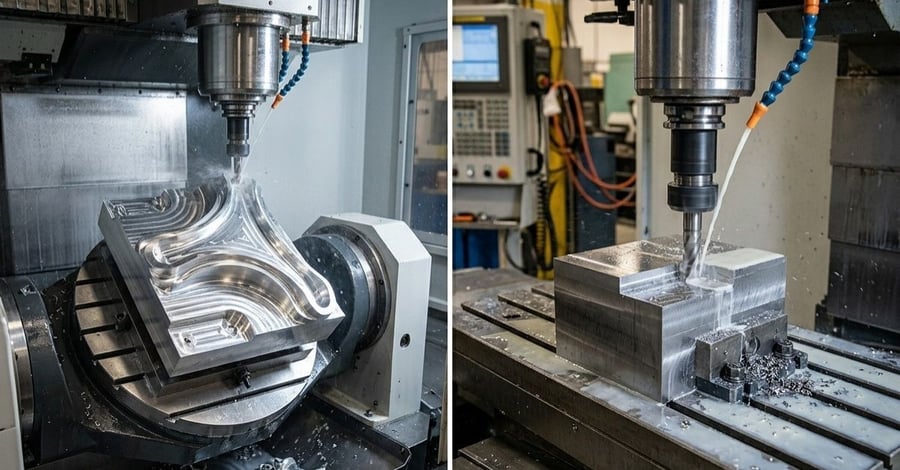
In 3-axis machining, the cutting tool moves along three linear axes: X (left-right), Y (front-back), and Z (up-down). The workpiece stays fixed. This covers an enormous range of parts: prismatic enclosures, mounting plates, brackets, pocketed housings, and most features you'd find on a straightforward defense or medical device subassembly. If every feature on your part is accessible from above or from one orthogonal face at a time, 3-axis will get there.
In 5-axis machining, two rotational axes are added, typically called A and B, or B and C depending on the machine configuration. The cutting tool can approach the workpiece from almost any angle without manual repositioning. That capability changes what's geometrically possible, but it also changes what machining that part costs and how long it takes to program.

When 3-Axis CNC Precision Machining Is the Right Call
Three-axis setups are the workhorse of precision machining for good reason. They're available on more machines, programmed by more operators, and they run faster cycle times on geometries they're suited for.
The geometry that belongs on a 3-axis machine is any part where all features align with the primary X, Y, or Z axes. Things like flat floors, vertical walls, orthogonal holes, and pockets with consistent depth, all machine cleanly in 3-axis. As outlined in Modus Advanced's design for manufacturability guidance, manufacturing efficiency improves dramatically when parts can be completed in three-axis operations with minimal setups.
The cost profile is the other reason to default to 3-axis when geometry allows. Programming time is shorter. Operator specialization requirements are lower. Equipment availability is higher. All three of those factors push the same direction on your quote.
Parts that are strong candidates for 3-axis include:
- Prismatic housings and enclosures: features on discrete faces that can be accessed by rotating the part between setups
- Mounting brackets and structural components: orthogonal hole patterns, slots, and pockets that align with the primary axes
- RF shielding enclosures: flat-floored cavities and vertical walls where 3-axis covers all functional features
- High-volume production parts: where cycle time per part is a primary cost driver
The main limitation of 3-axis is repositioning. When a part has features on multiple faces, it must be physically re-fixtured between operations. Each repositioning is a setup. Each setup takes time and introduces the possibility of accumulated positional error between features machined in different orientations.
3-axis is not the budget option. For geometry it's suited for, it's the correct engineering choice.
Essential Background Reading:
- Precision Manufacturing: Processes, Tolerances, Industries, and How to Choose the Right Partner: The end-to-end landscape of precision manufacturing. Definitions, process categories, industries, quality standards, and partner-evaluation framework.
- Precision Machining: Processes, Tolerance Thresholds, and Process Selection Logic: Core process taxonomy, turning, milling, grinding, EDM, and the tolerance thresholds that define precision at the design stage.
- CNC Precision Machining: Capabilities, Limitations, and What to Expect from a Modern Shop: A realistic picture of what modern CNC can and cannot do. Multi-axis capability, surface finish specs, material compatibility, and volume suitability.
- Machining Tolerance Chart: Understanding Standard vs. Tight Tolerances for Precision Manufacturing: A reference chart covering standard and tight tolerance ranges across CNC operations, with manufacturing impact at each level.
When 5-Axis CNC Precision Machining Justifies the Premium
Five-axis machining earns its cost when your geometry can't be reached from a fixed orientation, or when tight positional tolerances between features across multiple faces make accumulated setup error unacceptable.
The geometry that demands 5-axis falls into clear categories. Per design for manufacturability principles, five-axis requirements include angled holes or slots not aligned with primary axes, complex compound angles on multiple surfaces, undercut features accessible only from non-standard orientations, deep cavities with feature access from multiple angles, and parts requiring machining from multiple directions without repositioning.
If your part has even one of those conditions, pricing 5-axis is worth the conversation. If it has several, 5-axis is almost certainly the right answer regardless of cost.
When a 5-axis machine completes a part without repositioning, every feature on that part was machined from a shared coordinate system. Positional relationships between features are as tight as the machine's inherent accuracy. Split those same features across two 3-axis setups, and the tolerance relationship between them now includes fixturing repeatability, datum re-establishment, and measurement chain uncertainty. For parts with tight positional callouts across faces, that's a meaningful difference.
Parts that are strong candidates for 5-axis include:
- Complex aerospace structural components: compound-angle features and pocket entry points requiring a tilted tool approach
- Medical device housings with multi-directional bore features: where hole relationships across faces must hold tight positional tolerances
- Parts with true undercuts: features that can't be reached without tilting the tool
- Contoured surfaces: curved geometry that would otherwise require multiple 3-axis setups with index positioning
Specialized 5-axis programming requires more experienced operators and adds to both programming time and machine time compared to 3-axis. Equipment availability is also narrower. Not every machine shop runs 5-axis, which can affect scheduling and lead times. This is one factor to verify when you evaluate a precision machine shop before sending a drawing.
3-Axis vs. 5-Axis CNC Precision Machining
The table below captures the key tradeoffs across the factors that matter most at the design and sourcing stage.
| Factor | 3-Axis | 5-Axis |
|---|---|---|
| Geometry suitability | Prismatic, axially aligned features | Compound angles, undercuts, multi-face access |
| Setup time | Shorter per setup; multiple setups for complex parts | Longer programming; fewer or single setups |
| Positional accuracy across features | Dependent on fixturing repeatability between setups | Held within a single coordinate system |
| Programming complexity | Moderate | High; requires experienced CAM programmers |
| Operator skill requirement | Standard | Specialized |
| Equipment availability | Wide | More limited |
| Cost per part | Lower for simple-to-moderate geometry | Higher; justified by geometric complexity or tolerance requirements |
| Lead time risk | Lower | Higher if 5-axis equipment is constrained |
| Volume suitability | Excellent at high volume | Better suited for low-to-mid volume complex parts |
Related Content:
- CNC Machining Design Guidelines: 5-Axis vs. 3-Axis CNC Machined Parts: Design-focused guidelines covering axis selection, feature orientation, and how configuration choice affects programming and cost.
- Design for Manufacturability: CNC Machined Metal Parts Complete Engineering Guide: Comprehensive DFM guidance for machined metal parts. Corner radii, wall thickness, feature accessibility, and tolerance specification.
- Precision Machined Parts: Design Considerations That Determine Cost and Quality: DFM principles specific to precision machined parts. Tolerancing, feature accessibility, material selection, and surface finish callouts.
- Design Features That Can Reduce Your Lead Times and Costs for Machined Parts: Specific geometry and drawing decisions that reduce machining time, setup count, and total part cost.
- Sharp Corners on CNC Machined Parts: The Impossible Feature That's Killing Your Timeline: Why internal sharp corners can't be machined and what to specify instead to keep your part moving.
Tolerance Implications of Configuration Choice
Axis count affects what tolerances are achievable, and where they apply. Understanding this before tolerances get called out on a drawing can save both time and money.
Standard CNC machining tolerance at Modus Advanced is ±0.25 mm (±0.010"). Features machined within a single setup will hold their positional relationships to each other at or better than that baseline. When features are split across setups, tolerance relationships between them depend on how repeatable the fixturing and datum re-establishment are.
Where the Error Actually Comes From
Same part, same features, two routes. The difference is how many times it has to be re-referenced.
Swipe to compare both routes.
If a bore position relative to a slot matters to ±0.05 mm (±0.002"), both features belong in the same setup.
"The right answer isn't always the more capable machine."

Apply tight positional tolerances to features that will be machined together in one setup. If a bore position relative to a slot matters to within ±0.05 mm (±0.002"), both features need to be in the same setup. On a 3-axis machine, re-fixtured faces either need looser callouts or need to be re-evaluated. On a 5-axis machine, single-setup completion means those features can carry tighter callouts without extraordinary process controls. For a broader look at when standard tolerances stop being adequate, see high precision machining requirements for demanding aerospace, defense, and medical applications.
Tighter tolerances than standard are achievable with careful engineering, but they carry real cost and lead time consequences. The machining tolerance ranges below follow from published design for manufacturability guidance:
| Tolerance Range | Manufacturing Impact | Lead Time Effect | Cost Impact |
|---|---|---|---|
| ±0.13 mm (±0.005") | Standard CNC operations | Baseline | Standard rates |
| ±0.05 mm (±0.002") | Increased precision requirements | +25-50% | +50-100% |
| ±0.013 mm (±0.0005") | Specialized equipment/environment | +100-200% | +200-400% |
| ±0.005 mm (±0.0002") | Temperature control, stress relief | +300%+ | +500%+ |
Specify the loosest tolerance your design can genuinely accept. If a tighter callout doesn't serve assembly function or system performance, it adds cost and lead time with no functional return. Understanding tolerance stack-up implications during the design stage is far cheaper than resolving them after parts are in production.
Next Steps:
- How to Evaluate a Precision Machine Shop Before You Send a Single Drawing: Pre-engagement audit checklist for vetting a precision machine shop. Equipment, certifications, inspection capabilities, and culture fit.
- Precision CNC Machining Services: The Full-Service Stack That Separates a Partner from a Job Shop: How to identify gaps in current suppliers and set expectations for new ones across DFM, finishing, assembly, and program management.
- Precision Parts Manufacturing: Scaling from Prototype to Production Without Losing Repeatability: How process validation, fixturing consistency, and inspection scaling protect tolerance integrity as volume increases.
- Tolerance Design and Manufacturing Feasibility: Engineering Precision Into Practice: How to connect tolerance specifications to actual process capability before drawings go to the shop floor.
- Common CNC Machining Drawing Errors That Kill Your Lead Time and How to Avoid Them: The most frequent drawing mistakes that stall quoting, delay production, and inflate cost, and how to fix them before submission.
Does Your Part Geometry Require 5-Axis?
Before committing to a machining configuration, evaluate the geometry against these criteria.
Your part needs 5-axis CNC machining if any of the following are true:
- Angled holes or slots: bores or features that aren't aligned with the primary X, Y, or Z axes
- Compound angles on multiple surfaces: geometry requiring simultaneous angular approach from more than one direction
- True undercuts: features inaccessible from any orthogonal direction
- Tight positional tolerances across multiple faces: where accumulated setup error from re-fixturing would exceed tolerance budget
- Deep cavities requiring multi-angle access: pocket geometries that require tool approach from more than one orientation
- Complex contoured surfaces: curved geometry that can't be approximated in discrete indexed setups without unacceptable surface deviation
Your part is a strong 3-axis candidate if all of the following are true:
- All holes and slots align with primary axes
- All pocket floors are flat and parallel to the primary datum face
- Features on secondary faces can be accessed after a single re-fixturing step
- Positional tolerance relationships across faces are within what fixturing repeatability can reliably deliver
- Production volume is high enough that cycle time efficiency per part matters
If your geometry sits on the boundary, bring it to an engineer before the drawing is finalized. A geometry review at the design stage costs nothing. A machining configuration change after toolpaths are programmed costs real time. This is also where design considerations for precision machined parts can catch cost and quality problems before they're locked in.
Design Choices That Reduce 5-Axis Dependency
Not every part that appears to require 5-axis actually does. Several design decisions can shift a part from 5-axis territory back into 3-axis range, sometimes without any functional compromise.
The core strategy is feature orientation. Aligning holes, slots, and pockets with the primary X, Y, or Z axes is the single most effective way to reduce machining complexity. Angled features that seem natural in a CAD model often exist because no one asked whether the angle was functionally required.
Additional strategies that reduce 5-axis dependency include:
- Grouping angled features: if angled features are unavoidable, design them so they share a common orientation. A single indexed setup can handle them without full 5-axis motion.
- Converting undercuts to through-features: if a feature's function can be preserved as a through-slot or through-hole, it eliminates the undercut condition.
- Evaluating part splitting: splitting a complex part into two simpler 3-axis parts and joining them is sometimes faster and cheaper than machining a single 5-axis part.
- Designing with fixturing in mind: clear, stable datum surfaces that allow reliable re-fixturing between faces reduce the cost of multiple 3-axis setups.
The goal is always to match the manufacturing process to the geometry, not to force the geometry to justify a more capable machine. For specific design features that reduce lead times and costs for machined parts, the guidance applies regardless of which axis configuration you ultimately select.
See It In Action:
- Complex Tight Tolerance Precision CNC Machining for Medical Device Excellence: How tight tolerance CNC machining requirements play out in medical device applications where dimensional accuracy directly affects patient outcomes.
- Defense CNC Machining: How CNC precision machining serves defense applications. Tolerances, certifications, and the stakes when parts go into mission-critical systems.
- Precision CNC Machining Services: A Breakdown of Modus's Capabilities: A direct look at what Modus Advanced runs. Equipment, tolerances, materials, and how machining connects to downstream operations.
- Precision Sealing in Medical Device Design: Modus Advanced's Approach: How machined housing geometry and FIP gasket dispensing interact in medical device assemblies where sealing integrity is non-negotiable.
Configuration Choice: Downstream Cost, Lead Time, and Operations
The machining configuration decision doesn't end at the machine. At Modus Advanced, CNC precision machining is often the first operation in a sequence that includes plating, form-in-place (FIP) gasket dispensing, and final assembly of RF sub-assemblies. The axis choice has implications for everything downstream.
A 5-axis part that exits machining with tighter feature relationships requires less rework before gasket dispensing. Surfaces that hold better flatness tolerances produce more consistent gasket bead geometry. Plating stack-up on tight-tolerance features is easier to plan when the machined baseline is repeatable. The full-service CNC machining stack matters precisely because the machining step sets the baseline for every operation that follows.
Our suggestion: default to 3-axis unless your geometry genuinely requires otherwise, your tolerance stack demands single-setup completion, or both. When a part has compound angles, true undercuts, or tight positional tolerances across faces that can't share a 3-axis setup, 5-axis is the correct answer and the cost premium is appropriate.
When a part is prismatic and well-oriented, 5-axis adds cost and lead time with no geometric benefit. Understanding how contract manufacturing company structure affects access to both 3-axis and 5-axis capacity is worth factoring into your supplier evaluation.
Frequently Asked Questions
What is CNC precision machining?
CNC (computer numerical control) precision machining is a subtractive manufacturing process in which computer-controlled cutting tools remove material from solid stock to produce components with tight dimensional tolerances. "Precision" refers to the tolerance range the process can reliably hold: typically ±0.13 mm (±0.005") at standard operation, with tighter tolerances achievable under controlled conditions. It's used in aerospace, defense, and medical device manufacturing where dimensional accuracy directly affects system performance.
What is the difference between 3-axis and 5-axis CNC machining?
In 3-axis CNC machining, the cutting tool moves along three linear axes: X, Y, and Z. The workpiece stays fixed, and the part is re-fixtured manually to access different faces. In 5-axis CNC machining, two additional rotational axes allow the tool to approach the workpiece from nearly any angle in a single setup. The core difference is geometric access: 3-axis handles axis-aligned features efficiently, while 5-axis handles compound angles, undercuts, and multi-face features without repositioning.
When should I use 5-axis CNC instead of 3-axis?
Use 5-axis CNC when your part has angled holes or slots not aligned with primary axes, compound angles on multiple surfaces, true undercut features, or tight positional tolerances across faces that 3-axis re-fixturing can't reliably hold. If all features align with the primary X, Y, or Z axes, 3-axis is almost always the correct choice. It's faster, cheaper to program, and available on more equipment.
What types of parts require 5-axis CNC machining?
Parts that typically require 5-axis CNC machining include aerospace structural components with compound-angle features, medical device housings with bore relationships across multiple faces, components with true undercuts, and contoured surfaces that can't be approximated in indexed 3-axis setups. If a part's functional features can all be accessed from orthogonal directions, it likely doesn't require 5-axis.
How does 5-axis CNC machining improve accuracy?
Five-axis CNC improves positional accuracy between features by completing them in a single setup. When every feature is machined from the same coordinate system, positional relationships hold to the machine's inherent accuracy. When features are split across multiple 3-axis setups, each re-fixturing step introduces fixturing repeatability error, datum re-establishment uncertainty, and measurement chain variation. For parts with tight positional callouts across faces, the single-setup advantage is significant.
What tolerances can CNC precision machining achieve?
Standard CNC precision machining holds tolerances of ±0.13 mm (±0.005"). Tighter tolerances are achievable: ±0.05 mm (±0.002") with increased process controls, ±0.013 mm (±0.0005") with specialized equipment and environmental controls, and ±0.005 mm (±0.0002") with temperature stabilization and stress relief. Each step tighter carries meaningful lead time and cost implications. Specifying the loosest tolerance that genuinely serves your design is the right starting point. For a detailed breakdown of what tight tolerance CNC machining requires in practice, the tradeoffs are consistent across configurations.
How much does 5-axis CNC machining cost compared to 3-axis?
Five-axis CNC machining costs more than 3-axis for three compounding reasons: longer programming time due to complex toolpath generation, higher operator skill requirements, and more limited equipment availability. The cost delta varies by part complexity and shop, but the drivers are consistent across the industry. For geometry that genuinely requires 5-axis, the premium is justified. For geometry that 3-axis can handle, 5-axis adds cost with no quality benefit. Understanding what to look for in contract manufacturing services beyond price per part helps frame this decision in its broader sourcing context.
What certifications should a CNC precision machining shop have?
For aerospace and defense work, AS9100 certification is the primary quality management standard to verify. ISO 9001 certification covers general quality systems. ITAR (International Traffic in Arms Regulations) registration is required for defense-related parts. These certifications ensure the shop has documented, audited processes for traceability, non-conformance handling, and quality control (which matters when the parts end up in critical systems). For a complete breakdown of aerospace precision machining requirements including AS9100, ITAR, FAIR, and DFARS, those requirements apply regardless of which machining configuration your part needs.
If you're working on a part where configuration choice affects what comes after machining (e.g. plating, FIP gasket dispensing, or final sub-assembly), reach out to the Modus Advanced engineering team. We'll review your geometry before the drawing is finalized, because one day matters.