Key Points
- Missile manufacturers need more than machining: The most challenging components in a missile system require a partner who can machine metal housings, dispense precision gaskets, manage thermal loads, and apply specialized coatings — all under one roof.
- RF shielding is non-negotiable in guidance systems: Sensitive electronics in missile guidance and navigation demand effective electromagnetic interference (EMI) / radio frequency (RF) shielding to maintain signal integrity in high-vibration, high-temperature environments.
- FIP gasket precision is mission-critical: Form-in-place (FIP) gaskets dispensed to a bead tolerance of ±0.15 mm (±0.006") protect sensitive guidance electronics from contamination, pressure differentials, and electromagnetic interference.
- CMMC and DFARS compliance aren't optional: Any U.S. defense manufacturer supplying to missile programs must work with a partner who meets Cybersecurity Maturity Model Certification (CMMC) Level 2 certification standards and Defense Federal Acquisition Regulation Supplement (DFARS) requirements — protecting both the program and the supply chain.
- Vertical integration reduces program risk: When machining, FIP dispensing, coatings, and converting all happen under one roof, you eliminate hand-off points where delays compound and quality accountability disappears.
- One day matters: In missile defense, schedule is strategy. Every day saved in component development and production moves a critical system closer to the field.
What Missile Manufacturers Actually Need From a Manufacturing Partner
Building components for missile systems — whether guided munitions, missile defense interceptors, or hypersonic vehicle platforms — demands something most manufacturing partners can't deliver: the full stack. Missile manufacturers don't just need metal cut to spec. They need a partner who understands the interplay between structural housings, EMI protection, thermal management, sealing, and surface treatment — and who can execute across all of those disciplines without adding vendors, risk, or lead time to the program.
Missile defense system manufacturers in the U.S. operate in one of the most demanding procurement environments in the world. Tight tolerances, classified technical data, DFARS materials requirements, and the operational realities of hypersonic flight, underwater launch, or multi-stage separation leave very little margin for error — and zero tolerance for a manufacturing partner who can't keep up. For a closer look at what hypersonic missile manufacturers need when selecting sub-assembly and component partners, the stakes are even higher.
This article breaks down exactly how Modus Advanced supports missile manufacturers and OEMs across the full suite of manufacturing processes they need most. Whether you're developing custom manufacturing services for missile defense systems parts and components or sourcing for a specific interceptor program, the capabilities below are built to meet the requirement.
Metal Work & CNC Machining for Missile Components
Precision metal components sit at the heart of nearly every missile system. Structural housings, actuator brackets, guidance module enclosures, and RF shield substrates all start as metal stock and end as tightly toleranced, function-critical parts. The question isn't whether your partner can machine metal — it's whether they can machine it to your spec, on your schedule, with the quality systems and certifications your program demands.
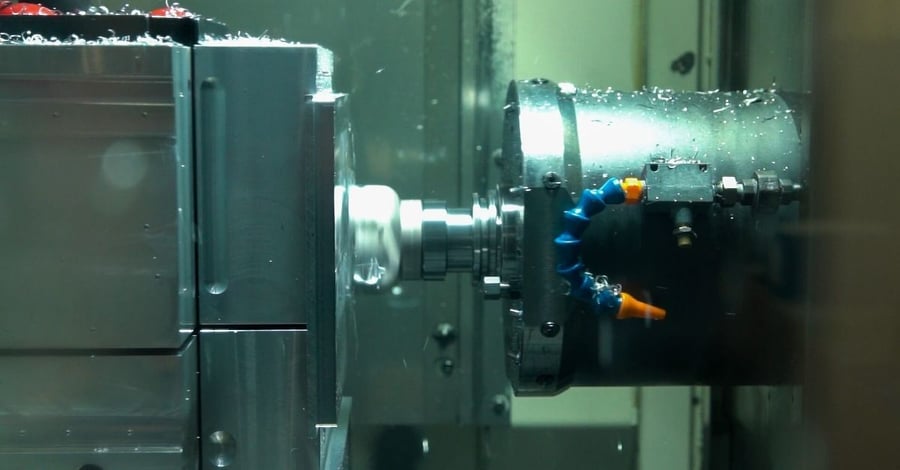
Modus Advanced operates a full suite of CNC machining capabilities, including 5-axis machining centers for complex geometry work that requires tool access from multiple angles in a single setup. Our standard CNC machining tolerance for metallic components is ±0.25 mm (±0.010"). When your design genuinely requires tighter tolerances — and in missile systems, some do — those requirements drive lead time and cost up. Confirming that tighter tolerances are truly function-driven before specifying them is always worth the engineering conversation.
Aluminum 6061 is our primary machining material, but we work across the full range of metals including steel, copper alloys, and specialty alloys suited to defense applications. Our CNC machining capabilities are most valuable when combined with downstream processes — FIP gasket dispensing, coatings, and material assembly — that turn a machined housing into a finished, field-ready sub-assembly. This is the model that drives our work supporting custom manufacturing for flight computer parts and components, where downstream integration is just as critical as the machining itself.
CNC Machining Capabilities at a Glance
Modus brings a range of CNC equipment to defense programs, each suited to specific part configurations and production requirements.
| Machine Type | Best For |
|---|---|
| Vertical Machining Center (VMC) | Flat plates, brackets, molds, single-face operations |
| Horizontal Machining Center (HMC) | Large, heavy parts; multi-sided machining; gravity-assisted chip evacuation |
| 5-Axis CNC | Complex contours, compound curves, turbine geometry, missile housing features requiring multi-angle access |
RF Shielding: Protecting Guidance Electronics in High-Threat Environments
Missile guidance systems, seekers, and communication modules are packed with sensitive electronics that cannot tolerate electromagnetic interference. A guidance computer hit with EMI at the wrong moment isn't just a performance issue — it's a mission failure. RF shielding is the line between a system that performs and one that doesn't.
Modus Advanced supports missile manufacturers with our SigShield™ process — a vertically integrated approach to building RF shields that combines CNC machining, FIP gasket dispensing, plating and coatings, and the addition of RF absorbers and thermal materials, all in a single production flow.
This turnkey approach eliminates the vendor juggling act that fragments accountability and compounds lead times across multi-step RF shield programs. Engineers designing sealed guidance enclosures will find our resource on custom RF gasket design for missile guidance systems useful for understanding the design decisions that govern shielding performance.
What Makes RF Shielding for Missiles Especially Demanding
Missile electronics enclosures face operating conditions that commercial RF shields are never designed to survive. The shielding solution has to account for all of these simultaneously.
- Vibration and shock: Launch loads and flight dynamics subject shielding components to high-frequency vibration and mechanical shock that can fatigue gasket materials or compromise housing geometry over time.
- Thermal cycling: Missiles operate across extreme temperature swings — from cold storage to aerodynamic heating. Materials that don't perform across that range introduce failure modes.
- Size and weight constraints: Every gram counts in a missile system. Material selection and housing geometry need to balance shielding effectiveness against mass budget.
- Seeker frequency considerations: Guidance seekers operate at specific frequency bands. Shield design needs to attenuate EMI without interfering with intended operating frequencies.
FIP gaskets are the preferred solution for EMI-shielded missile enclosures. Our dispensing process achieves bead tolerances of ±0.15 mm (±0.006"). For programs using Parker Chomerics CHO-FORM materials specifically, bead heights in the 0.89–1.57 mm (0.035"–0.062") range are maintained to ±0.15 mm (±0.006"), with start/stop/T-joint zones carrying an additional ±0.15 mm (±0.006") tolerance allowance.
Essential Background Reading:
- Missile Defense Component Manufacturing — Compliance and Quality Standards: An overview of the compliance and quality requirements defense contractors must meet when sourcing missile defense components.
- Custom Parts Manufacturing From Prototype to Production in Mission-Critical Industries: How manufacturing partners support programs through the full development lifecycle in defense and aerospace.
- Custom Manufacturers vs. Standard Suppliers — Making the Right Choice: A practical framework for deciding when a custom manufacturing partner is necessary versus standard off-the-shelf supply.
- FIP Gaskets for Missile Electronics — ITAR and CMMC Manufacturing Considerations: How compliance requirements shape FIP gasket manufacturing decisions for missile programs.
Form-in-Place Gaskets: Precision Sealing for Custom Missile Parts
FIP gaskets are one of the most consequential components in a sealed missile electronics enclosure, and they're also one of the most underspecified. Engineers focus, reasonably, on housing geometry, materials, and shielding attenuation. But a gasket dispensed imprecisely or from the wrong material family can undermine all of that work.
Form-in-place dispensing places a liquid elastomeric material directly onto the housing, where it cures in place to create a precisely dimensioned, permanently bonded gasket. No assembly step, no gasket orientation issue, and no risk of the gasket shifting under load.
For small, intricate missile electronics enclosures with complex geometry, FIP is often the only practical sealing solution. For programs where elastomeric geometry and setting tolerances for elastomeric or flexible parts are still being worked out, our engineering team can help establish realistic tolerance targets before the design is locked.
FIP Material Selection for Missile Defense Applications
Material selection for FIP gaskets in missile applications requires balancing multiple performance demands at once. The table below summarizes key material categories and their considerations for defense use.
| Material Type | Key Properties | Defense Application Fit |
|---|---|---|
| Nickel-filled silicone | High conductivity, moderate temperature range | EMI shielding in standard guidance enclosures |
| Silver-filled silicone | Highest conductivity, premium cost | High-performance shielding, low-contact-resistance applications |
| Carbon-filled silicone | Cost-effective, moderate conductivity | Secondary shielding, less demanding EMI environments |
| Non-conductive silicone | Environmental sealing only | Structural sealing where EMI performance is handled separately |
Dispensing is as much an art as it is a science. The learning curve in FIP dispensing is steep, and the consequences of a poorly dispensed gasket in a missile application are severe. Modus brings years of production dispensing experience across defense programs, with quality validation processes built specifically to catch dimensional variation before a housing leaves our facility.
Thermal Management for Missile Electronics
Heat is a persistent challenge in missile electronics packaging. Guidance systems, seekers, and onboard processors generate heat that needs a path out of the enclosure, and in a sealed, space-constrained missile body, that path has to be engineered deliberately. Passive thermal management using precision thermal interface materials (TIMs) is a standard approach, and converting those materials accurately is critical to the thermal performance they're designed to deliver.
Modus Advanced converts thermal interface materials as part of our broader converting capability, cutting TIMs to exact specifications for placement between heat-generating components and structural housings or heat spreaders. The converted material becomes the thermal bridge that determines how effectively your electronics shed heat in flight.
Thermal management also extends to coatings. For components where radiation is the primary heat dissipation mechanism. Common in missile systems that don't rely on convection. Thermal control coatings that manage emittance and absorptance values are a critical design tool, not an add-on.
Related Content:
- FIP Gaskets for Missile Seeker Housings: Design and manufacturing considerations for form-in-place gaskets on seeker housing applications.
- Thin-Wall Elastomeric Gasket Tolerances. How to Hold Tolerance Without Losing the Wall: Engineering guidance on achieving tight tolerances in thin-wall elastomeric gasket applications.
- Die Cutting vs. Waterjet vs. CNC Knife Cutting for Conductive Silicone: Process comparison to help engineers select the right cutting method for conductive silicone gaskets and seals.
- RF Enclosures for Hypersonic Vehicle Avionics: How RF enclosure design and manufacturing adapt for the extreme environments of hypersonic flight.
- The Best Process for Building a Custom RF Shield: A walkthrough of the manufacturing process decisions that determine custom RF shield performance and lead time.
Coatings for Missile Defense Components
Surface treatment in missile applications goes well beyond corrosion protection. Coatings serve active thermal, optical, electrical, and environmental functions that are specified in the design. Not added as an afterthought.
Modus Advanced applies thermal and optical control coatings including optical black coatings, high-emissivity ESD coatings, electrically conductive coatings, and anti-reflective optical coatings. These find application across a range of missile component types:
- Thermal control coatings: Applied to guidance electronics housings to manage component temperatures across the full mission thermal profile.
- Optical black coatings: Applied to seeker components to reduce stray light reflections that could interfere with target discrimination.
- Electrically conductive coatings: Support grounding and bonding requirements across multi-piece housings.
- Corrosion protection coatings: Ensure components remain dimensionally stable and functionally reliable across the full logistics chain, from storage to launch.
Our vertical integration extends to coatings. Housings machined in our CNC cells can proceed directly to our coating line, then to FIP dispensing, without leaving our facility. That eliminates shipping cycles and coordination overhead that stretch lead times on multi-vendor programs.
Next Steps:
- Custom Component Manufacturing for Radar Seekers: Manufacturing considerations specific to radar seeker components, where precision and shielding requirements are most demanding.
- Custom Manufacturer of Missile Interceptor Parts and Components: How Modus Advanced supports interceptor programs across the full manufacturing stack.
- Custom Manufacturers for Ground-Based Interceptor Parts and Components: Program-specific manufacturing requirements for ground-based interceptor systems.
- Custom Part Manufacturing for Space-Based Interceptors: How manufacturing requirements shift for interceptor components designed for space environments.
- Design for Manufacturability. Optimizing Converted Parts and Custom Gaskets: DFM principles that help engineers avoid costly redesigns in converted parts and gasket programs.
Converting: Gaskets, Absorbers, and Soft Goods for Missile Systems
Beyond FIP dispensing, converting. The process of cutting and forming sheet elastomeric materials into finished components. Supplies a wide range of parts that go into missile systems. Environmental seals, vibration damping pads, RF absorbers, and thermal interface materials all typically originate as sheet stock that needs to be cut to precise dimensions before integration.
Modus Advanced supports converting through die cutting, waterjet cutting, and CNC digital cutting. Each method has a specific fit within missile component programs.
- Die cutting: High-volume production of elastomeric gaskets and seals where geometry is consistent and tooling investment is justified by volume. Dense solid materials (BL2 designation) under 25.4 mm (1.0") are die cut to a standard tolerance of ±0.38 mm (±0.015").
- Waterjet cutting: Complex geometry or specialty materials where heat-affected zones from other cutting methods would compromise material properties. No tooling required, making it well suited to prototype and low-volume production.
- CNC digital cutting: Intricate shapes, narrow walls, and detailed patterns at prototype or production volumes without hard tooling. Dense materials (BL2) under 25.4 mm (1.0") are cut to ±0.38 mm (±0.015") standard tolerance.
For programs where tighter tolerances are required. Which some missile sealing applications genuinely do demand. Our engineering team works through the design requirements to determine whether tighter tolerances are achievable and what the lead time and cost implications are. Programs that require custom molded rubber components alongside converted soft goods can also reference our guide to the best manufacturing method to prototype custom molded rubber parts for a practical comparison of prototyping approaches.
CMMC Compliance and DFARS: Why Your Manufacturing Partner's Compliance Posture Is Your Problem Too
If you're a missile defense system manufacturer, you already know the compliance landscape. DFARS requirements govern what materials can flow through your supply chain and how your technical data must be handled. CMMC governs how your supply chain protects controlled unclassified information (CUI). Both flow down. Meaning your suppliers' compliance posture directly affects your program's compliance posture.
Modus Advanced is CMMC Level 2 Certified, ITAR registered, AS9100 certified, and ISO 9001 certified. Our cybersecurity framework protects your technical data, drawings, specifications, program information. Through every stage of manufacturing. MILSPEC materials are available for programs where material certifications are required for traceability and compliance. All manufacturing is 100% domestic, which matters for DFARS compliance and supply chain security in programs where foreign material is explicitly restricted.
For programs that involve form-in-place gaskets for missile electronics with ITAR and CMMC manufacturing considerations, the compliance requirements touch every stage of the manufacturing process. Not just data handling.
Modus Advanced Compliance and Certification Summary
The following certifications and compliance achievements are relevant to missile defense and defense manufacturing programs.
| Certification / Compliance | Relevance to Missile Programs |
|---|---|
| CMMC Level 2 Certified | Protects CUI including technical drawings, specifications, and program data |
| ITAR Registered | Required for defense and military-related technologies and components |
| AS9100 Certified | Aerospace and defense quality management system standard |
| ISO 9001 Certified | Foundation quality management certification |
| DFARS Compliance | Domestic sourcing and material certification requirements for U.S. defense supply chains |
| MILSPEC Materials | Certified materials meeting military specification requirements |
| Made in the USA | 100% domestic manufacturing; supply chain security for defense procurement |
Compliance is infrastructure. A supplier who treats it as such. Rather than a box to be checked. Protects your program at every phase.
See It In Action:
- Interceptor Vibration Isolation. Protecting Missile Electronics in Extreme Dynamic Environments: A real-world look at how vibration isolation solutions are engineered for missile interceptor electronics.
- Ballistic Missile Defense Manufacturing: Manufacturing considerations and capabilities for ballistic missile defense program components.
- Custom Metal Parts Manufacturing. Advanced Techniques for Aerospace and Defense Applications: How advanced CNC machining and metal fabrication techniques serve the most demanding defense and aerospace programs.
- Hypersonic Missile Defense Component Manufacturing. Engineering Solutions for Mission-Critical Systems: Engineering and manufacturing approaches for hypersonic missile defense components operating at Mach 5+.
The Vertical Integration Advantage for Missile Manufacturers
Missile programs are schedule-sensitive in ways that few other programs are. A delay in component delivery doesn't just push a milestone. It can cascade through test schedules, production commitments, and program reviews. Every vendor hand-off in a multi-step manufacturing process is a potential schedule risk point.
Modus Advanced's vertically integrated model addresses this directly. CNC machining, FIP gasket dispensing, coatings, and converting all operate under one roof. A missile electronics housing can move from machining to coating to FIP dispensing to conversion assembly without a single external shipping cycle. That's lower risk. Because quality accountability doesn't get handed off with the part.
This same model is what enables us to support custom manufacturing services for missile platforms and custom manufacturers for ground-based interceptor parts and components at the pace those programs demand.
Our engineering team. More than 10% of our staff are engineers. Engages with your designs before manufacturing starts. Design for Manufacturability (DFM) feedback from our team has helped programs catch tolerance stack-up issues, material compatibility concerns, and FIP groove geometry problems before they become production failures. For missile defense system manufacturers who can't afford redesigns late in a development program, that engineering partnership has real value.
Frequently Asked Questions: Custom Manufactured Parts for Missile Programs
These questions reflect what engineers and program managers ask most often when evaluating custom manufacturing partners for missile defense components.
What certifications should a custom manufacturer have to support missile programs?
At minimum, look for CMMC Level 2 Certification, ITAR registration, and AS9100 certification. ISO 9001 certification provides the quality management foundation, while DFARS compliance and MILSPEC material availability matter for supply chain traceability. Domestic manufacturing (Made in USA) is often required for classified or export-controlled programs.
Why is vertical integration important for missile component manufacturing?
Vertical integration eliminates vendor hand-offs. Which are the primary source of schedule delays and quality accountability gaps in complex component programs. When CNC machining, FIP dispensing, coatings, and converting happen under one roof, a housing moves from raw stock to finished sub-assembly without a single external shipping cycle.
What tolerances are achievable for FIP gaskets used in missile electronics enclosures?
Standard FIP bead tolerances are ±0.15 mm (±0.006"). For Parker Chomerics CHO-FORM materials, bead heights in the 0.89, 1.57 mm (0.035", 0.062") range are maintained to ±0.15 mm (±0.006"), with an additional ±0.15 mm (±0.006") allowance at start/stop/T-joint zones. Tighter tolerances may be achievable but increase lead time and cost.
What cutting methods are used for elastomeric gaskets and soft goods in missile assemblies?
Die cutting suits high-volume production of consistent geometries. Waterjet cutting handles complex geometry and heat-sensitive materials without a heat-affected zone. CNC digital cutting delivers intricate shapes and narrow wall sections at prototype or production volumes without hard tooling. Standard tolerance for dense solid (BL2) materials under 25.4 mm (1.0") is ±0.38 mm (±0.015") for both die and CNC digital methods. A deeper look at die cutting vs. waterjet vs. CNC knife cutting for conductive silicone helps clarify which process fits your specific program requirements.
How does RF shielding differ for missile applications versus commercial electronics?
Missile RF shielding must survive launch vibration, mechanical shock, and extreme thermal cycling that commercial shield designs are never rated for. Seeker frequency compatibility, mass budget constraints, and sealed enclosure geometry add further complexity. FIP gaskets are the preferred sealing method for EMI-shielded missile enclosures because they bond directly to the housing and cannot shift under load. For a full breakdown of RF shielding for missile defense systems and manufacturing compliance requirements, our engineering team has covered the topic in detail.
Partner With Modus Advanced for Your Missile Manufacturing Programs
Missile manufacturers need a partner who can execute. Not a parts vendor who ships to a drawing. CNC machining, RF shielding, FIP dispensing, thermal management, coatings, and converting under one roof, backed by CMMC Level 2 certification, ITAR registration, and AS9100 quality systems, makes Modus Advanced the right choice for custom manufacturer of missile interceptor parts and components programs at every phase of development and production.
Your technology protects service members, enables deterrence, and defines the capability edge of the systems you build. Our job is to make sure every custom manufactured part we produce meets the standard that mission demands. One day matters, and in missile defense, that's not a slogan. It's the operating tempo your program runs at.
Submit your design to our engineering team today. We'll get you a quote within 24 hours.