
Understanding THERM-A-GAP GEL 37 for Data Center Applications
THERM-A-GAP GEL 37 is a single-component dispensable thermal gel with 3.7 W/m-K thermal conductivity specifically formulated for data center thermal management applications. Parker Chomerics designed this material to address the critical heat dissipation challenges in modern server architectures where processors, GPUs, and memory modules generate substantial thermal loads within confined spaces. For engineers new to thermal interface materials, the complete engineer's guide to thermal management covers material selection fundamentals from basic principles through manufacturing considerations.
The material arrives fully cured as a paste-like compound that requires no mixing, curing, or secondary processing. This characteristic distinguishes thermal gels from two-part compounds that require precise ratio control and cure time management. Data center equipment manufacturers can integrate GEL 37 into automated dispensing processes with confidence that material properties remain consistent throughout production runs.
Data centers face unprecedented thermal challenges as computing densities continue to increase. Server processors now dissipate power levels that traditional thermal interface approaches struggle to manage effectively.
THERM-A-GAP GEL 37 provides the combination of automated dispensing compatibility, low assembly forces, and reliable long-term performance that high-volume server manufacturing demands. Engineers evaluating thermal conductivity requirements across different applications can compare this material against alternatives like THERM-A-GAP GEL 75, which offers higher thermal conductivity for demanding heat dissipation scenarios.

Read the full guide to THERM-A-GAP materials here.
Essential Background Reading:
- Complete Engineer's Guide to Thermal Management: Foundational thermal management principles from material selection through manufacturing considerations
- Essential Guide to Thermal Management: Core concepts for engineers addressing complex thermal environments in electronic systems
- Parker Chomerics Thermal Material Guide: Overview of Chomerics thermal interface material product families and selection criteria
- Thermal Interface Materials Selection Guide: Decision framework for choosing between thermal pads, gels, and other TIM formats
THERM-A-GAP GEL 37 Technical Specifications
Engineers designing data center equipment require precise material specifications to evaluate thermal interface options. The following table defines the complete performance envelope for THERM-A-GAP GEL 37 in server and storage applications.
Property | Value | Test Method |
Thermal Conductivity | 3.7 W/m-K | ASTM D5470 |
Minimum Bondline Thickness | 0.10 mm (0.004") | Chomerics |
Operating Temperature Range | -55°C to 200°C (-67°F to 392°F) | Chomerics |
Specific Gravity | 3.1 | ASTM D792 |
Flow Rate (30cc syringe, 2.54 mm orifice, 621 kPa) | 30 g/min | Chomerics |
Heat Capacity | 1 J/g-K | ASTM E1269 |
Dielectric Strength | 7 kVac/mm (180 Vac/mil) | Chomerics |
Volume Resistivity | 10¹⁴ ohm-cm | ASTM D257 |
Dielectric Constant @ 100 kHz | 5.8 | ASTM D150 |
Flammability Rating | UL 94 V-0 | UL 94 |
Outgassing (TML / CVCM) | 0.18% / 0.07% | ASTM E595 |
Shelf Life | 18 months | Chomerics |
Related Content:
- THERM-A-GAP GEL 75 Material Guide: Higher thermal conductivity alternative for demanding heat dissipation scenarios
- THERM-A-GAP GEL 30 Complete Guide: Lower thermal conductivity option with similar gap-filling characteristics
- THERM-A-GAP PAD 30 Practical Guide: Die-cut thermal pad alternative for memory module geometries
- THERM-A-GAP PAD 70TP Guide: Pre-cut pad format comparison for assembly requirements
- Advanced Thermal Gel Dispensing Capabilities: Manufacturing process details for automated thermal gel application
Data Center Thermal Management Challenges
Modern data center architectures concentrate enormous computing power within increasingly compact server configurations. A single 1U server may house multiple high-power processors alongside dense memory arrays and high-speed networking components.
This concentration of heat-generating components within constrained chassis dimensions creates thermal management challenges that demand precision-engineered solutions. Our essential guide to thermal management provides foundational knowledge for engineers addressing these complex thermal environments.
Server processors represent the primary thermal load in most data center configurations. Contemporary CPU designs dissipate power levels exceeding 300 watts while occupying packages measured in square centimeters. Graphics processing units supporting AI workloads can exceed 700 watts in thermal design power. These concentrated thermal loads require efficient heat transfer pathways to heatsink assemblies.
The architecture of data center servers includes multiple thermal interface requirements beyond primary processors. Memory modules transfer heat to chassis structures or dedicated cooling assemblies during sustained high-bandwidth operations. Solid-state drives generate significant heat during read/write operations within compact NVMe form factors. Power supplies and voltage regulator modules dissipate thermal loads throughout the power distribution system. Each interface demands thermal management materials that accommodate manufacturing tolerances while maintaining low thermal resistance.
THERM-A-GAP GEL 37 Applications in Server Architectures
Processor and GPU Thermal Interfaces
Central processing units and graphics processing units operate at power densities that demand efficient thermal pathways to heatsink assemblies. The 0.10 mm (0.004") minimum bondline thickness of THERM-A-GAP GEL 37 enables engineers to achieve thin thermal interfaces that minimize thermal resistance between processor lids and heatsink bases.
The low compression force characteristic proves critical in processor applications. Modern BGA packages and advanced packaging technologies can be sensitive to mechanical stress during heatsink mounting operations. GEL 37 deforms readily under typical heatsink mounting pressures without transmitting excessive force to processor packages or solder connections. This characteristic protects sensitive package interconnects while ensuring consistent thermal contact across the interface area.
Memory Module Thermal Management
Server memory configurations have grown increasingly dense as data center workloads demand greater bandwidth and capacity. Multiple DIMMs per channel across numerous memory channels create thermal management challenges. Memory modules generate heat during high-bandwidth operations that must transfer efficiently to chassis structures or dedicated memory cooling assemblies.
THERM-A-GAP GEL 37 can be dispensed onto memory module thermal interfaces in automated production processes. The paste-like consistency enables controlled placement in patterns optimized for memory chip layouts. The material accommodates the manufacturing tolerances inherent in memory module assemblies while maintaining reliable thermal contact throughout the operational lifetime. For applications where die-cut thermal pads better suit memory module geometries, engineers should evaluate THERM-A-GAP PAD 30 as a practical alternative for data center thermal management.
Solid-State Drive Applications
Enterprise solid-state drives concentrate substantial thermal loads within compact form factors. NVMe drives operate at high sustained throughput rates that generate concentrated heat within small package dimensions. THERM-A-GAP GEL 37 provides thermal interfaces between drive packages and heatsinks or chassis surfaces that dissipate this concentrated thermal load.
The dispensable nature of the material enables application to the irregular surface topographies common in SSD assemblies. The gel conforms to component geometries without requiring the precision thickness matching that die-cut thermal pads demand. This flexibility simplifies thermal management in storage arrays where numerous drives operate in close proximity.
Power Supply and Voltage Regulator Modules
Power conversion throughout server power distribution systems generates thermal loads that require effective management. Voltage regulator modules supplying processor cores operate at high currents with efficiency losses manifesting as heat. THERM-A-GAP GEL 37 serves thermal interface applications in power delivery components where conformability and low assembly stress are critical design requirements.
Dispensing Process Considerations for Production
Automated dispensing of THERM-A-GAP GEL 37 requires attention to process parameters that influence material placement accuracy and consistency. Data center equipment manufacturers implementing thermal gel dispensing should establish process controls that deliver repeatable material volume and pattern geometry throughout production runs.
Engineers seeking guidance on selecting the right build to print manufacturer for thermal management production should evaluate dispensing capabilities alongside quality systems and engineering support.
The material exhibits a flow rate of 30 grams per minute under test conditions using a 30cc syringe with 2.54 mm (0.100") orifice at 621 kPa (90 psi). Production dispensing parameters will vary based on actual equipment configurations, dispensing tip geometries, and material temperature. Process development should establish parameters specific to your manufacturing environment.
Critical Dispensing Parameters
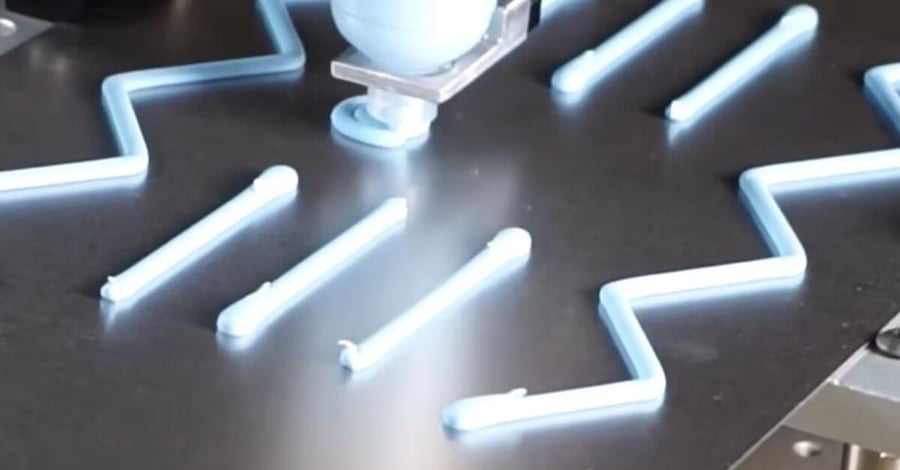
- Dispensing pattern selection: Engineers can specify dot, line, serpentine, or spiral patterns based on component geometry and heat source distribution. Pattern selection influences material volume requirements and thermal contact uniformity across the interface.
- Material temperature control: Consistent material temperature during dispensing promotes repeatable flow characteristics and deposit geometry. Temperature variations affect material viscosity and can create dimensional inconsistencies in dispensed patterns.
- Tip geometry and maintenance: Dispensing tip selection influences bead profile and should align with required deposit dimensions. Regular tip maintenance prevents material buildup that can affect deposit consistency.
- Compression during assembly: The material requires compression during heatsink or lid assembly to achieve the thin bondlines that minimize thermal resistance. Assembly pressure spreads the material across mating surfaces while reducing bondline thickness.
- Visual inspection protocols: The blue color enables inspection for material presence and coverage completeness before final assembly operations. Automated vision systems can verify dispensing quality in high-volume production environments.
Design Guidelines for Data Center Engineers
Engineers specifying THERM-A-GAP GEL 37 for data center servers should consider design factors that influence thermal interface performance and manufacturing efficiency throughout the product lifecycle.
Gap Accommodation and Stack-Up Tolerance
Thermal gels excel at accommodating manufacturing tolerances in component stack-ups. The material compresses to fill gaps while maintaining thermal contact across the interface. Engineers should analyze the range of gap dimensions that thermal interfaces must accommodate and verify that dispensed material volume provides adequate coverage at both minimum and maximum gap conditions.
Component dimensional variations arise from multiple sources including substrate warpage, component package tolerances, and heatsink flatness specifications. THERM-A-GAP GEL 37 accommodates these variations through its conformable nature and ability to flow under compression pressure. The material fills voids that would otherwise create thermal resistance in the interface. Applications requiring lower thermal conductivity with similar gap-filling characteristics may benefit from THERM-A-GAP GEL 30 for data center thermal management.

Surface Preparation Requirements
The material adheres to most metal and metalized surfaces commonly found in server assemblies. Clean surfaces free from oils, debris, and residues promote consistent thermal contact. Engineers should specify appropriate cleaning procedures for mating surfaces in production documentation.
Surface contamination can compromise adhesion and thermal contact. Manufacturing processes should include surface preparation steps that remove flux residues, handling oils, and particulate contamination before thermal gel application. Isopropyl alcohol wipes or similar cleaning methods typically provide adequate surface preparation for thermal gel applications.
Rework and Field Service Considerations
The reworkable nature of THERM-A-GAP GEL 37 simplifies component replacement during manufacturing rework and field service operations. The gel can be removed without specialized solvents or abrasive processes that might damage component surfaces. This characteristic reduces the cost and complexity of service procedures for data center equipment throughout its operational lifetime.
Component failures in data center servers require field replacement that inevitably disturbs thermal interfaces. Traditional thermal pads may tear during removal and require complete replacement. Thermal greases can spread throughout the service area creating cleanup challenges. GEL 37 wipes clean from surfaces enabling straightforward thermal interface renewal during component replacement operations.
Regulatory and Environmental Compliance
THERM-A-GAP GEL 37 carries RoHS compliance certification and meets UL 94 V-0 flammability requirements. The low outgassing characteristics — 0.18% total mass loss and 0.07% collected volatile condensable materials per ASTM E595 — make the material suitable for applications with sensitivity to outgassing constituents.
Partnering with Modus Advanced on Thermal Management
Modus Advanced supports data center equipment manufacturers with thermal management applications including THERM-A-GAP GEL 37 dispensing. Our engineering team provides guidance on material selection, process development, and design for manufacturability throughout the product development cycle.
Thermal gel dispensing represents one element of our broader thermal management capabilities. We support engineers with thermal interface material selection, converting operations for die-cut thermal pads, and assembly of thermal solutions into customer sub-assemblies. This range of capabilities enables engineers to consolidate thermal management supply chain requirements with a single manufacturing partner.
Our quality systems — including AS9100 and ISO 9001 certifications — support the demanding quality requirements of data center equipment manufacturing. Engineers benefit from documented processes, inspection capabilities, and traceability systems that align with enterprise equipment quality expectations.
Submit your thermal management design to our engineering team for feedback on material selection and manufacturing approach. We respond to quote requests within 48 hours to keep your development timeline moving forward.
Next Steps:
- Thermal Gap Pad Compression Optimization: Performance optimization through proper selection and application techniques
- Thermal Contact Resistance Engineering: Solutions for maximizing heat transfer efficiency at thermal interfaces
- Understanding Thermal Impedance: Critical design parameters for high-performance thermal management systems
- Selecting a Build-to-Print Manufacturer: Complete guide to evaluating manufacturing partners for thermal management production
- Thermal Management Applications: Explore full range of thermal management capabilities and solutions
Frequently Asked Questions About THERM-A-GAP GEL 37
What makes THERM-A-GAP GEL 37 suitable for data center applications?
THERM-A-GAP GEL 37 combines 3.7 W/m-K thermal conductivity with single-component dispensable formulation that requires no curing or secondary processing. This combination enables automated high-volume production while delivering reliable thermal performance in server applications. The material operates across -55°C to 200°C (-67°F to 392°F), accommodating both air-cooled and liquid-cooled data center architectures. Low compression force requirements protect sensitive components while the 0.10 mm (0.004") minimum bondline enables thin thermal interfaces that minimize thermal resistance.
How does thermal gel dispensing compare to die-cut thermal pads?
Thermal gel dispensing offers several advantages for data center applications. Dispensing eliminates the inventory complexity of maintaining multiple thermal pad thicknesses for different component stack-ups. A single material accommodates the full range of gap dimensions through controlled dispensing volume and compression. Automated dispensing enables high-volume production with consistent material placement.
The conformable nature fills irregular surfaces and accommodates manufacturing tolerances more effectively than pre-cut pads. Engineers comparing dispensable gels against pad alternatives should evaluate THERM-A-GAP PAD 70TP thermal gap pads for data center applications where pre-cut formats better suit assembly requirements.
See It In Action:
- Medical Device Manufacturing Case Study: How Modus solved thermal adhesive assembly challenges through rapid iteration
- Telecommunications Partnership Case Study: Building a 10-year strategic relationship with robust quality processes
- Thermal Management Resource Center: Complete collection of thermal management guides, data sheets, and engineering resources
- Thermal Interface Material Data Sheets: Technical specifications for Parker Chomerics and other thermal interface materials
Can THERM-A-GAP GEL 37 be used with both air cooling and liquid cooling?
Yes. The -55°C to 200°C (-67°F to 392°F) operating temperature range accommodates thermal cycling in both air-cooled and liquid-cooled server architectures. The material maintains consistent thermal and mechanical properties across this temperature range. Data center operators transitioning from air cooling to liquid cooling can use the same thermal interface material across both cooling architectures.
How do I determine the right dispensing pattern for my application?
Dispensing pattern selection depends on component geometry, heat source distribution, and assembly constraints. Dot patterns work well for small, localized heat sources. Line patterns suit elongated heat source geometries. Serpentine and spiral patterns distribute material across larger areas with multiple heat sources. Our engineering team can evaluate your specific application and recommend dispensing patterns that optimize thermal performance while accommodating your assembly process requirements.